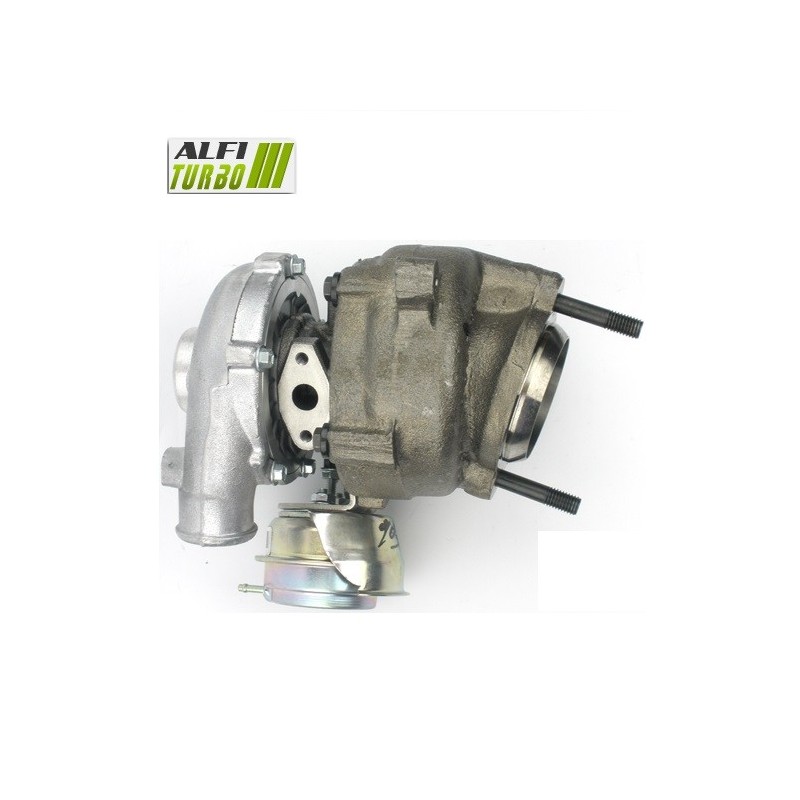
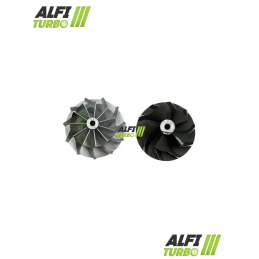
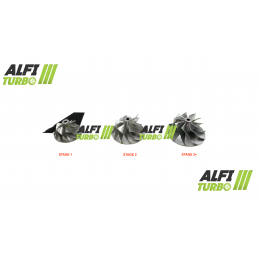
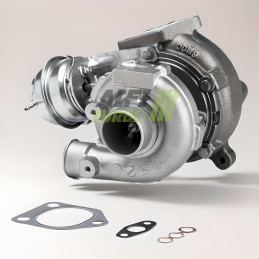
This hybrid turbo for engine Bmw 2.0 Diesel The M47 D20 (204D1) features d'an internal mechanism designed to adjust the flow rate' d'compressor air'. The three models on offer all feature an MFS compressor wheel Performance, a 360° bearing stop and high-speed balancing on a Cimat VSR test bench.
The documented assignments relate to several Bmw 3 Series E46 and 5 Series E39, saloon and Touring models. Compatibility must be confirmed using the turbo’s part number d'origin'.
Available products — Stage 1, Stage 2 and Stage 2+
Stage 1
Compressor wheel: High-capacity MFS Performance
Dimensions: 37.91 / 49.00 mm
Blade configuration: 6+6
Bearing stop: 360°
Balancing: 150,000 rpm on a Cimat VSR test bench
This assembly uses an MFS wheel Performance 37.91 / 49.00 mm. Its 6+6 configuration is designed to optimise the compressor’s performance and air-flow capacity, without compromising the engine’s ultimate power output.
Stage 2
Compressor wheel: High-capacity MFS oversized Performance
Dimensions: 43.01 / 56.02 mm
Blade configuration: 6+6
Carter d'Admission:' re-profiled for to receive the wheel oversized
Bearing stop: 360°
Balancing: 150,000 rpm on a Cimat VSR test bench
The Stage 2 pairs a wheel oversized to a casing d're-profiled intake'. This adaptation makes it possible to d'accommodate the new geometry and may alter the flow rate' d'air flow and the behaviour of the turbocharger, depending on the selected settings'.
Stage 2+
Compressor wheel: High-capacity MFS oversized Performance
Dimensions: 41.58 / 56.02 mm
Blade configuration: 6+6
Carter d'Admission:' re-profiled for to receive the wheel oversized
Bearing stop: 360°
Balancing: 150,000 rpm on a Cimat VSR test bench
The Stage 2+ is fitted with an MFS wheel Performance 41.58 / 56.02 mm and a casing d'adapted admission'. Its specific dimensions can affect the compressor’s flow rate and response; the choice of stage must therefore be consistent with the engine’s overall configuration.
What is a hybrid turbo ?
A hybrid turbo retains a suitable turbocharger design for to receive internal components that differ from the configuration d'origin'. Depending on the modification, changes may relate to the compressor wheel, its dimensions, the geometry of its blades, the casings, the thrust bearing or the balancing.
The aim is d'adjust the compression capacity and flow rate' d'air'. However, a hybrid turbo is not defined solely by the appearance of its impeller: the dimensions, aerodynamics, machining of the housings and the overall coherence of the unit are all crucial factors.
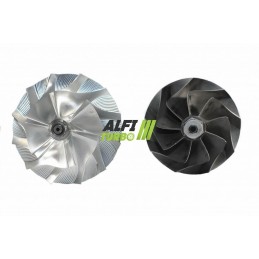
MFS compressor wheel: standard or Performance ? ?
MFS stands for ‘Milled From Solid’, meaning a wheel machined from a solid block. This term describes the manufacturing process, but does not in itself guarantee an increase in throughput d'air'.
A standard MFS wheel can retain a geometry equivalent to that d'origin'. An MFS wheel Performance may have a diameter, profile or blade configuration suited to the intended purpose. On this product, the wheels shown have a 6+6 configuration and dimensions specific to each stage.
A standard MFS wheel can be just as shiny as an MFS wheel Performance. It is not its appearance that determines its performance, but its geometry and its ability to move more d'air'. A higher flow rate can help to generate more power when the engine is set up and managed appropriately, although this alone does not guarantee a specific result.
Why does the geometry of the blades affect the flow rate? d'air?' ?
The compressor wheel draws in and then compresses the air admitted by the engine. Its diameter, profile, height, width and the arrangement of the blades influence its aerodynamic behaviour and the amount d'the amount of air it can move under certain conditions'.
The result also depends on the compressor housing, the turbine assembly, the boost pressure and the engine tuning. A wheel with a larger diameter therefore does not automatically guarantee better performance and may affect the response time as well as the range d'optimal use'.
Reliability and balancing of the hybrid turbocharger
The 360° stop, documented for each stage, helps to distribute the axial forces around the axis. It helps to ensure the mechanical integrity of the assembly, without making the turbo immune to poor lubrication or incorrect fitting.
The rotor is balanced at high speed, at 150,000 rpm on a Cimat VSR test bench. The aim of this operation is to minimise vibrations and mechanical stresses during operation.
Engine remapping and tuning
The farm d'A hybrid turbo may require adjustments to the engine mapping, boost pressure and fuel supply'. Systems d'intake, cooling, dThe exhaust system, as well as the clutch or gearbox, must also be checked depending on the level of preparation.
The wastegate must be adjusted during the fitting and remapping of the ECU. A hybrid turbo does not automatically guarantee a power increase without appropriate tuning of the entire engine system.
Turbo part numbers
OEM part numbers
11652247297
11652247297F
11652247297G
11652247297H
11652247901
11652247901H
11652247905
11652247905H
11652248901
11652248901G
11652248905
11652248905G
Manufacturer’s part numbers
700447-0001
700447-0003
700447-0004
700447-0005
700447-0006
700447-0007
700447-0008
700447-1
700447-3
700447-4
700447-5
700447-5008S
700447-6
700447-7
700447-8
Compatible vehicles and assignments
Bmw
3 (E46) — PC — 116 hp
2.0 Diesel — September 2001 to March 2003
M47 D20 (204D1)
3 (E46) — PC — 129 hp
2.0 Diesel — February 1998 to August 2001
M47 D20 (204D1)
3 (E46) — PC — 136 hp
2.0 Diesel — April 1998 to September 2001
M47 D20 (204D1)
3 Touring (E46) — PC — 115 hp
2.0 Diesel — October 2002 to March 2003
M47 D20 (204D1)
3 Touring (E46) — PC — 136 hp
2.0 Diesel — March 2000 to September 2001
M47 D20 (204D1)
5 (E39) — PC — 136 hp
2.0 Diesel — February 2000 to June 2003
M47 D20 (204D1)
5 Touring (E39) — PC — 136 hp
2.0 Diesel — February 2000 to September 2003
M47 D20 (204D1)
Additional technical specifications
Product type: hybrid turbo
Engine: Bmw 2.0D
Fuel: Diesel
Documented power ratings: 115, 116, 129 and 136 hp
Engine code : M47 D20 (204D1)
Documented periods: February 1998 to September 2003, depending on the assignment
Installation: configuration plug & play, with wastegate adjustment during fitting and remapping
Assembly instructions
⚠️ WARNING — IMPORTANT BEFORE ASSEMBLY
Before installation, identify and rectify the cause of the previous fault. Check the lubrication circuit, the supply and the return d'oil, as well as the cleanliness of the ducts'.
Check the intake and ensure there are no foreign objects present. Carry out the priming in accordance with the relevant guidelines and follow the manufacturer’s instructions. The wastegate must be adjusted during the installation and tuning of the engine management system.
If a lubrication fault is not rectified, it may lead to the turbocharger failing again.
How do you choose the right turbo ?
Check the part number marked on the turbocharger d'original', then compare it with the OEM and manufacturer's specifications in this data sheet. Also check the model, generation, body style, engine type and power output in hp, the assembly period and the engine code. Having the same engine is not always enough to confirm compatibility.
⚠️ Check your turbo’s part numbers
Before placing your order, Compare the part number on your turbocharger d'origin' using the references given in this fact sheet. Having the same motor does not always guarantee compatibility.
If you are in any doubt, please contact us with the full part number from your turbocharger.