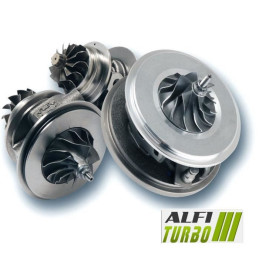
This hybrid turbo for engine variants 1.5 DCI is available in three levels of preparation. Each configuration includes an MFS compressor wheel Performance with a 360° bearing stop and high-speed balancing.
The documented applications cover several models Nissan and Renault ranging from 103 to 110 hp. When choosing a course, you should take into account the engine’s configuration and the aim of the preparation.
Available products — Stage 1, Stage 2 and Stage 2+
Stage 1
Compressor wheel: MFS Performance high-speed
Dimensions shown: 31.00 / 46.00 mm
Blade configuration: 5+5
Bearing stop: 360°
Balancing: 150,000 rpm on a Cimat VSR test bench
This setup uses an MFS wheel Performance whose dimensions and blade configuration are suited to a flow rate d'increased air'. The final performance depends on the engine management system and the overall mechanical configuration.
Stage 2
Compressor wheel: MFS Performance high-speed oversized
Dimensions shown: 36.50 / 49.00 mm
Blade configuration: 7+7
Carter d'Admission:' Reprofiled for to receive the new wheel
Bearing stop: 360°
Balancing: 150,000 rpm on a Cimat VSR test bench
The Stage 2 is fitted with a wheel oversized and a casing d're-profiled intake'. These changes may increase the vehicle’s range d'air, whilst altering the response conditions and d'Operation of the turbocharger'.
Stage 2+
Compressor wheel: MFS Performance high-speed oversized
Dimensions shown: 39.50 / 52.00 mm
Blade configuration: 11+0
Carter d'Admission:' Reprofiled for to receive the new wheel
Bearing stop: 360°
Balancing: 150,000 rpm on a Cimat VSR test bench
This version uses the largest compressor wheel on record for this product, with an 11+0 configuration and a suitable casing. Its use must be consistent with the engine’s requirements and the other components of the set-up.
What is a hybrid turbo ?
A hybrid turbo is based on a specially adapted turbocharger design for to receive internal components that differ from the configuration d'origin'. Depending on the service, modifications may relate to the compressor wheel, its geometry, its dimensions, or the housing d'Intake, stop and balancing'.
The aim is d'adjust the compression capacity and flow rate' d'air'. However, a hybrid turbo is not defined solely by the appearance of its impeller: the balance between the components and the adaptation of the engine management system remain crucial.
MFS compressor wheel: standard or Performance ? ?
MFS stands for ‘Milled From Solid’, meaning a wheel machined from a solid block. This designation describes a manufacturing process and does not, in itself, guarantee an increase in throughput d'air'.
A standard MFS wheel can retain a geometry equivalent to that d'origin'. An MFS wheel Performance may have a diameter, profile or blade configuration suited to the preparation objective, such as the configurations documented for the different stages of this product’s production.
A standard MFS wheel can be just as shiny as an MFS wheel Performance. It is not its appearance that determines its performance, but its geometry and its ability to move more d'air'. A higher flow rate can help to generate more power when combined with the right engine tuning, although this alone does not guarantee results.
Why does the geometry of the blades affect the flow rate? d'air?' ?
The compressor wheel draws in and then compresses the air intended for the engine. Its diameter, profile, height, width and the arrangement of its blades influence the aerodynamic behaviour of the compressor.
The right geometry can move more d'air under certain conditions'. The result also depends on the compressor housing, the turbine section, the boost pressure and the engine tuning. A larger wheel therefore does not automatically guarantee a better result and may affect the response time as well as the range d'optimal use'.
Reliability and balancing of the hybrid turbocharger
The 360° stop fitted to all three stages helps to distribute the axial forces acting on the rotating assembly. It does not exempt d'proper lubrication nor d'a compliant assembly'.
Every work placement offers d'high-speed balancing at 150,000 rpm on a Cimat VSR test bench'. This procedure is designed to minimise vibrations and mechanical stresses on the rotor, although it cannot compensate for a fault d'installation, lubrication or d'oil supply'.
Engine remapping and tuning
It may be necessary to adjust the engine mapping and boost pressure control for make the most of the hybrid turbo’s features. Depending on the level of preparation: fuel injection, exhaust, air cooling d'The intake, clutch or gearbox must also be checked or adjusted'. The wastegate must be adjusted during fitting and remapping. No increase in power happens automatically without proper preparation.
Turbo part numbers
OEM part numbers
1441100Q0F
8200405203
8200507856
8200578381
8200625683
7701476883
7711368560
Manufacturer’s part numbers
54399700030
54399700070
54399800030
54399800070
54399880030
54399880070
54399900030
54399900070
KP39-030
KP39-070
Compatible vehicles and assignments
Nissan
Qashqai — 106 hp
1.5 DCI — from 2007, end date unspecified
Qashqai Phase 2 — 106 hp
1.5 DCI — from 2010, end date unspecified
Qashqai Plus 2 Phase 2 — 106 hp
1.5 DCI — from 2010, end date unspecified
Tiida — 106 hp
1.5 DCI — from 2007, end date unspecified
Tiida Saloon — 106 hp
1.5 DCI — from 2007, end date unspecified
Renault
Clio 3 — 106 hp
1.5 DCI — from 2005, end date unspecified
Clio 3 Estate — 106 hp
1.5 DCI — from 2008, end date unspecified
Clio 3 Estate Phase 2 — 106 hp
1.5 DCI — from 2009, end date unspecified
Clio 3 Phase 2 — 106 hp
1.5 DCI — from 2009, end date unspecified
Clio 3 Society Phase 2 — 106 hp
1.5 DCI — from 2009, end date unspecified
Fluence — 106 hp
1.5 DCI — from 2009, end date unspecified
Large Scenic 2 — 106 hp
1.5 DCI — from 2004, end date unspecified
Kangoo 2 — 103/105 hp
1.5 DCI — from 2007, end date unspecified
Kangoo 2 — 106 hp
1.5 DCI — from 2007, end date unspecified
Laguna 3 — 110 hp
1.5 DCI — from 2007, end date unspecified
Laguna 3 Phase 2 — 110 hp
1.5 DCI — from 2010, end date unspecified
Megane 2 — 106 hp
1.5 DCI — from 2002, end date unspecified
Modus — 106 hp
1.5 DCI — from 2004, end date unspecified
Scenic 2 — 106 hp
1.5 DCI — from 2003, end date not specified
Scenic 3 — 105 hp
1.5 DCI — from 2009, end date unspecified
Additional technical specifications
Product type: Hybrid Turbo
Engine: 1.5 DCI
Fuel: Diesel
Documented power ratings: 103, 105, 106 and 110 hp depending on the application
Period covered: From 2002 onwards, depending on the application
Installation: Configuration plug & play, unchanged d'documented installation'
Assembly instructions
⚠️ WARNING — IMPORTANT BEFORE ASSEMBLY
Before fitting, identify and rectify the cause of the previous fault. Check the lubrication circuit, the supply and the return d'oil', as well as ensuring that all ducts are clean.
Check the intake and ensure there are no foreign objects present. Carry out the priming in accordance with the relevant guidelines and follow the manufacturer’s instructions. The wastegate adjustment and mapping must be adapted during installation and tuning.
If a lubrication fault is not rectified, it may lead to the turbocharger failing again.
How do you choose the right turbo ?
Check the part number marked on the turbocharger d'origin and compare it with the OEM and manufacturer part numbers listed on this sheet'. Also check the make, model, generation, body style, engine type and power output in hp, theYear the mounting code and the engine code, where available.
The same engine can be fitted with several different turbo set-ups. If you are in any doubt, please contact us, quoting the full reference number shown on your part d'origin'.
⚠️ Check your turbo’s part numbers
Before placing your order, Compare the part number on your turbocharger d'origin' using the references given in this fact sheet. Having the same motor does not always guarantee compatibility.