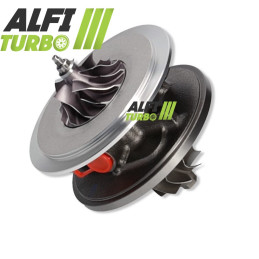
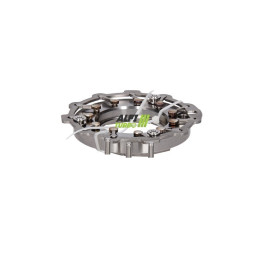
This hybrid turbo for engine variants 1.9 dCi and DI-D is fitted with an internal mechanism designed to adjust the compression capacity and flow rate dair. The three available levels feature an MFS compressor wheel Performance, a 360° bearing stop and high-speed balancing on a Cimat VSR bench.
The documented assignments include, in particular, several Mitsubishi Carisma and Space Star, Nissan Firstly, Renault Espace, Laguna, Mégane and Scénic, as well as Volvo S40 and V40. The benchmark for turbochargers dThe origin must always be checked before placing an order.
Available products — Stage 1, Stage 2 and Stage 2+
Stage 1
Compressor wheel: MFS Performance high-speed
Dimensions: 37.91 / 49.00 mm
Blade configuration: 6+6
Level: 360° stop
Balancing: high speed at 150,000 rpm on a Cimat VSR test bench
This preparation retains its position plug & play whilst fitting an MFS compressor wheel Performance designed for change the travel capacity dcompressor air.
Stage 2
Compressor wheel: MFS Performance high-speed oversized
Dimensions: 38.50 / 52.19 mm
Blade configuration: 11+0
Carter d’Admission:’ reprofiled for to receive the wheel oversized
Level: 360° stop
Balancing: high speed at 150,000 rpm on a Cimat VSR test bench
The larger diameter requires the casing to be re-profiled d’admission’. This combination can increase flow capacity, with performance depending on the mapping and the overall engine configuration.
Stage 2+
Compressor wheel: MFS Performance high-speed oversized
Dimensions: 39.61 / 56.02 mm
Blade configuration: 11+0
Carter d’Admission:’ reprofiled for to receive the wheel oversized
Level: 360° stop
Balancing: high speed at 150,000 rpm on a Cimat VSR test bench
This version uses the largest wheel documented on this page. Its size may affect the available flow rate, response time and range d…optimal use; the result therefore depends on the vehicle being fully prepared.
What is a hybrid turbo ?
A hybrid turbo is based on an existing architecture that has been adapted for to receive different internal components. Depending on the modification, changes may relate to the compressor wheel, its dimensions, the geometry of the blades, or the housing d’intake, the stop system and balancing’.
The aim is d’adjust the compression capacity and flow rate’ dair. However, a hybrid turbo is not defined solely by the appearance of its impeller: the consistency between the components, the machining and the engine management system remains crucial.
MFS compressor wheel: standard or Performance ? ?
MFS stands for ‘Milled From Solid’, meaning a wheel machined from a solid block. This manufacturing process does not, on its own, guarantee an increase in flow rate: a standard MFS impeller may retain a geometry equivalent to that d’origin’.
A standard MFS wheel can be just as shiny as an MFS wheel Performance. It is not its appearance that determines its performance, but its geometry and its ability to move more dair. For the designs presented here, the dimensions and configurations of the blades are specified for each work placement. A higher flow rate can help to generate more power, but only with the appropriate engine tuning.
Why does the geometry of the blades affect the flow rate? d’air ?
The compressor wheel draws in and then compresses the air fed to the engine. Its diameter, profile, height, width and the arrangement of the blades all influence its aerodynamic behaviour. The right geometry can move more dair under certain conditions, but a larger wheel does not automatically guarantee a better result. The casing, the turbine section, boost pressure and mapping also influence the response and the range dUse.
Reliability and balancing of the hybrid turbocharger
The 360° stop, as documented in the three training courses, helps to distribute the axial forces of the rotor. High-speed balancing at 150,000 rpm on a Cimat VSR test bench is designed to minimise vibrations and mechanical stresses. However, it does not compensate for a lack of lubrication or incorrect installation.
Engine remapping and tuning
The mapping and management of boost pressure need to be adjusted for make the most of the turbo’s features. Depending on the course and the vehicle, the fuel injection, exhaust and air cooling systems d’The intake system, clutch or gearbox may also need to be checked or adjusted’. The wastegate must be adjusted during the installation and tuning of the ECU.
Turbo part numbers
OEM part numbers
MW30623801
441100Q0E
14411-00Q0E
14411AW301
14411-AW301
7701472775
7701473526
7701474960
7701477263
7701478024
7711135336
7711135749
7711368748
7711369336
7711497146
8200110519
8200110519A
8200256077
8200332125
8200369581
8200381645
8200683855
36000721
36002419
8602254
8602478
8602872
8603688
125195
1101245
T912130
172-05430
17205430
1441100Q0E
1441100Q0K
8200544912
AR0121
Manufacturer’s part numbers
708639
708639-0002
708639-0003
708639-0004
708639-0005
708639-0006
708639-0007
708639-0010
708639-10
708639-2
708639-3
708639-4
708639-5
708639-5010S
708639-9010S
708639-5011S
708639-9011S
708639-6
708639-7
708640
53039700196
53039800196
53039880196
53039900196
53039980196
708639-2010
Compatible vehicles and assignments
Mitsubishi
Carisma (DA_) — 115 hp
Diesel • September 2000 to June 2006
Engine code : F9Q2
Carisma Saloon (DA_) — 115 hp
Diesel • September 2000 to June 2006
Engine code : F9Q2
Space Star MPV (DG_A) — 115 hp
Diesel • October 2002 to December 2004
Engine code : F9Q2
Nissan
Primera (P12) — 116 hp
Diesel • August 2002 to October 2007
Engine code : F9Q
Primera (P12) — 120 hp
Diesel • April 2003 to October 2007
Engine code : F9Q
Primera Estate (WP12) — 116 hp
Diesel • August 2002 to October 2007
Engine code : F9Q
Primera Estate (WP12) — 120 hp
Diesel • from April 2003, end date not specified
Engine code : F9Q
Primera Hatchback (P12) — 116 hp
Diesel • August 2002 to October 2007
Engine code : F9Q
Primera Hatchback (P12) — 120 hp
Diesel • April 2003 to October 2007
Engine code : F9Q
Renault
Espace IV (JK0/1_) — 116 hp
Diesel • April 2003 to February 2005
Engine code : F9Q 820
Espace IV (JK0/1_) — 120 hp
Diesel • from November 2002, end date unspecified
Engine codes: F9Q 680, F9Q 820, F9Q 826
Grand Scénic II (JM0/1_) — 120 hp
Diesel • April 2004 to May 2006
Engine code : F9Q 812
Laguna II (BG0/1_) — 92 hp
Diesel • March 2004 to May 2005
Engine code : F9Q 664
Laguna II (BG0/1_) — 110 hp
Diesel • January 2005 to August 2007
Engine codes: F9Q 670, F9Q 674, F9Q 758
Laguna II (BG0/1_) — 120 hp
Diesel • March 2001 to September 2007
Engine codes: F9Q 650, F9Q 670, F9Q 674, F9Q
Laguna II Grandtour (KG0/1_) — 92 hp
Diesel • March 2004 to May 2005
Engine code : F9Q 664
Laguna II Grandtour (KG0/1_) — 110 hp
Diesel • Jan 2005 to Dec 2007
Engine codes: F9Q 674, F9Q 758
Laguna II Grandtour (KG0/1_) — 120 hp
Diesel • March 2001 to September 2007
Engine codes: F9Q 670, F9Q 674, F9Q 750
Mégane II (BM0/1_, CM0/1_) — 90 hp
Diesel • November 2002 to December 2005
Engine code : F9Q 808
Mégane II (BM0/1_, CM0/1_) — 92 hp
Diesel • March 2004 to August 2006
Engine code : F9Q 808
Mégane II (BM0/1_, CM0/1_) — 115 hp
Diesel • November 2002 to February 2008
Engine codes: F9Q 800, F9Q 803, F9Q 804, F9Q
Mégane II (BM0/1_, CM0/1_) — 120 hp
Diesel • November 2002 to February 2008
Engine code : F9Q 800
Mégane II Coupé-Cabriolet (EM0/1_) — 115 hp
Diesel • September 2003 to March 2009
Engine codes: F9Q 800, F9Q 803, F9Q 804, F9Q
Mégane II Coupé-Cabriolet (EM0/1_) — 120 hp
Diesel • September 2003 to March 2009
Engine code : F9Q 800
Mégane II Estate (KM0/1_) — 90 hp
Diesel • April 2004 to December 2005
Engine code : F9Q 808
Mégane II Estate (KM0/1_) — 92 hp
Diesel • March 2004 to February 2007
Engine code : F9Q 808
Mégane II Estate (KM0/1_) — 115 hp
Diesel • May 2005 to July 2009
Engine code : F9Q 818
Mégane II Estate (KM0/1_) — 120 hp
Diesel • August 2003 to July 2009
Engine code : F9Q 800
Mégane II Saloon (LM0/1_) — 90 hp
Diesel • September 2003 to December 2005
Engine code : F9Q 808
Mégane II Saloon (LM0/1_) — 92 hp
Diesel • from March 2004, end date not specified
Engine code : F9Q 808
Mégane II Saloon (LM0/1_) — 120 hp
Diesel • from September 2003, end date not specified
Engine code : F9Q 800
Scénic II (JM0/1_) — 116 hp
Diesel • June 2006 to November 2008
Engine codes: F9Q 803, F9Q 804, F9Q 812, F9Q
Scénic II (JM0/1_) — 120 hp
Diesel • June 2003 to May 2006
Engine code : F9Q 812
Volvo
S40 I (644) — 115 hp
Diesel • July 2000 to December 2003
Engine code : D 4192 Three-bedroom flat
V40 Estate (645) — 115 hp
Diesel • July 2000 to June 2004
Engine code : D 4192 Three-bedroom flat
Additional technical specifications
Product type: hybrid turbo
Engine: 1.9 dCi / DI-D
Fuel: diesel
Documented power ratings: 90, 92, 110, 115, 116 and 120 hp
Editing: design plug & play, unchanged d’establishment’
Assembly instructions
⚠️ WARNING — IMPORTANT BEFORE ASSEMBLY
Identify and rectify the cause of the previous fault before d’fit the turbo’.
Check the lubrication circuit, the supply and the return doil. Check that the ducts and the intake are clean and free from foreign objects.
Carry out the priming in accordance with the relevant guidelines and follow the manufacturer’s instructions. The wastegate adjustment and engine management tuning must be carried out by a qualified professional.
If a lubrication fault is not rectified, it may lead to the turbocharger failing again.
How do you choose the right turbo ?
Check the part number marked on the turbocharger d…the original and compare it with the OEM and manufacturer’s specifications in this data sheet. Also check the make, model, generation, body style, engine type and power output in hp, the years of manufacture and the engine code.
An identical motor does not always guarantee compatibility, as there may be several different configurations within the same range.
⚠️ Check your turbo’s part numbers
Before placing your order, Compare the part number on your turbocharger d’origin’ using the references given in this fact sheet. Having the same motor does not always guarantee compatibility.
If in doubt, please contact ALFI TURBO, quoting the reference number clearly visible on your turbo’s nameplate.