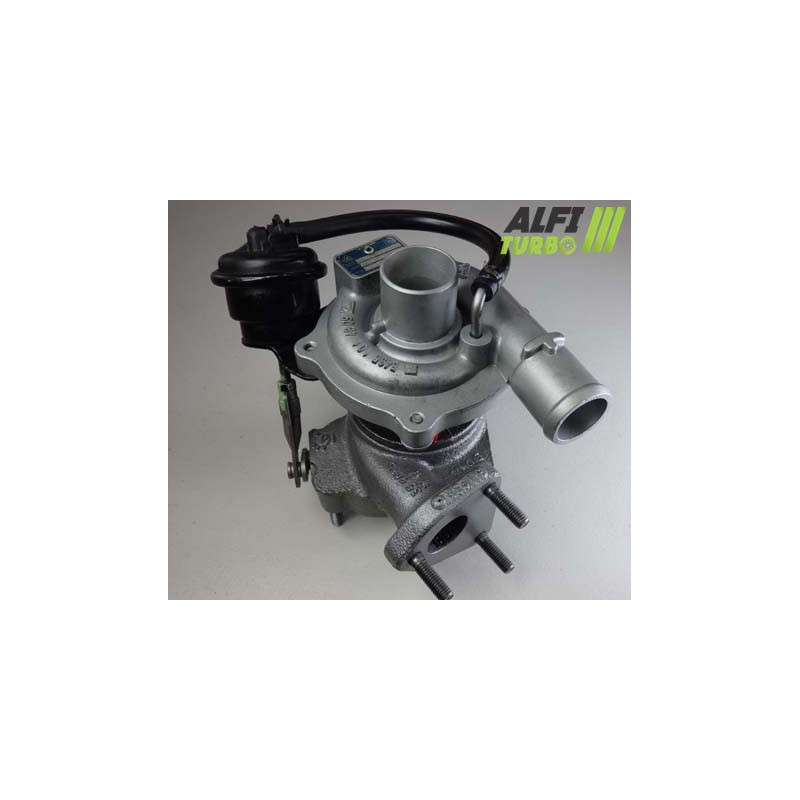
This hybrid turbo for engine variants 1.3 DDIS, CDTI, JTD, MJT and MJTD is based on an internal mechanism designed to adjust the flow rate d’air and compression capacity. Depending on the upgrade package chosen, it is fitted with a high-flow MFS compressor wheel, a 360° thrust bearing and additional modifications to the casings or the turbine section.
Its assembly method plug & play is documented without any external alterations. The assignments cover, amongst other things, several models Fiat, , Lancia, , Opel and Suzuki ;the turbo part number dThe origin must be verified before any order is placed.
Available products — Stage 1, Stage 2 and Stage 3
Stage 1
Compressor wheel: High-capacity MFS
Stop: 360° bearing
Balancing: high speed at 150,000 rpm on a Cimat VSR test bench
This preparation acts primarily on the compressor wheel in order to d’adjust the flow rate’ d’air, whilst retaining a configuration suitable for a Installation without modification documented external.
Stage 2
Compressor wheel: High-capacity MFS oversized
Carter d’Admission:’ reprofiled for to receive the new wheel oversized
Stop: 360° bearing
Balancing: high speed at 150,000 rpm on a Cimat VSR test bench
Reprofiling the casing allows d’fit the compressor wheel’ oversized. This change may affect the compressor’s flow capacity and behaviour; its operation depends on the engine configuration and the mapping.
Stage 3
Compressor wheel: High-capacity MFS oversized
Carter d’Admission:’ reprofiled for to receive the new wheel oversized
Stop: 360° bearing
Turbine wheel: high-speed oversized
Turbine casing: reprofiled for to receive the new wheel oversized
Balancing: high speed at 150,000 rpm on a Cimat VSR test bench
This procedure relates to the compressor and turbine sections. Adjusting the size of the impellers and reshaping the casings can increase flow capacity, but may also alter the response time and the range doptimal use.
What is a hybrid turbo ?
A hybrid turbo uses a specially adapted turbocharger design for to receive internal components that differ from the configuration d’origin’. Depending on the modification, the changes may involve the compressor wheel, the turbine wheel, the casings, the thrust bearing system and the balancing.
The aim is d’adjust the compression capacity and flow rate’ dair. However, a hybrid turbine is not defined solely by the appearance of its impeller: the geometry of the components, how they are assembled and the quality of the machining are crucial factors.
MFS compressor wheel: standard or Performance ? ?
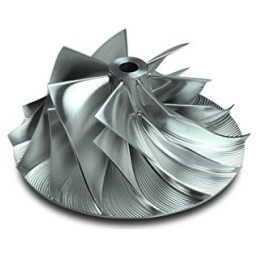
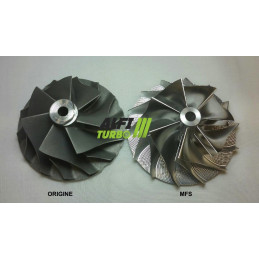
MFS stands for ‘Milled From Solid’, meaning a wheel machined from a solid block. This manufacturing process does not, in itself, mean that the wheel offers a higher flow rate. A standard MFS wheel can retain a geometry equivalent to that d’origin’.
An MFS wheel Performance may be designed with a geometry suited to the application: profile, height, width, diameter or blade arrangement, provided these characteristics are documented. On this product, the wheels are described as high-flow MFS models, with a version oversized to the Stage 2 and Stage 3.
A standard MFS wheel can be just as shiny as an MFS wheel Performance. It is not its appearance that determines its performance, but its geometry and its ability to move more dair. A higher flow rate can help to increase power output, provided the engine has been suitably prepared.
Why does the geometry of the blades affect the flow rate? d’air ?
The compressor wheel draws in and then compresses the air fed to the engine. Its diameter, profile, height, width and the arrangement of its blades have a direct influence on its aerodynamic behaviour.
The result also depends on the compressor housing, the impeller and the turbine housing, the boost pressure and the engine tuning. A larger wheel is not automatically more suitable for all uses and may affect response time.
Reliability and balancing of the hybrid turbocharger
The 360° stop, documented for each stage, helps to distribute the axial forces acting on the rotating assembly. It does not exempt d’proper lubrication nor d’a compliant installation’.
The rotor is balanced at high speed – 150,000 rpm – on a Cimat VSR test bench, in order to minimise vibrations and mechanical stresses. This balancing does not compensate for a circuit d’faulty oil, contamination or an error’ d’installation’.
Engine remapping and tuning
The farm dA hybrid turbo may require adjustments to the engine mapping, boost pressure and wastegate setting. Depending on the level of preparation: fuel injection, exhaust, air cooling dThe intake, clutch or gearbox must also be checked and, if necessary, adjusted.
Turbo part numbers
Manufacturer’s part numbers
54359700006
54359800006
54359880006
54359900006
Compatible vehicles and assignments
Fiat
500 / 500 C — 1.3 MJTD — 95 hp
From 2012, month and end date unspecified — engine code unspecified
Albea — 1.3 JTD — 70 hp
From 2002, month and end date unspecified — engine code unspecified
Doblo — 1.3 CDTI — 70 hp
From 2003, month and end date unspecified — engine code unspecified
Doblo — 1.3 MJTD — 70 hp
From 2004, month and end date unspecified — engine code unspecified
Doblo 2–1.3 MJTD — 75 hp
From 2006, month and end date unspecified — engine code unspecified
Doblo Cargo 2 — 1.3 MJTD — 75 hp
From 2006, month and end date unspecified — engine code unspecified
Fiorino — 1.3 CDTI — 75 hp
From 2003, month and end date unspecified — engine code unspecified
Grande Punto — 1.3 CDTI — 70 hp
From 2003, month and end date unspecified — engine code unspecified
Grande Punto (199) — 1.3 MJTD — 75 hp
From 2005, month and year unspecified — engine code unspecified
Grande Punto — 1.3 MJTD — 75 hp
From 2005, month and year unspecified — engine code unspecified
Grande Punto Current (199/299) — 1.3 MJTD — 75 hp
From 2009, month and end date unspecified — engine code unspecified
Grande Punto Van — 1.3 MJTD — 75 hp
From 2005, month and year unspecified — engine code unspecified
Idea — 1.3 CDTI — 70 hp
From 2003, month and end date unspecified — engine code unspecified
Idea — 1.3 JTD — 70 hp
From 2003, month and end date unspecified — engine code unspecified
New Fiorino — 1.3 MJTD — 75 hp
From 2007, month and year unspecified — engine code unspecified
Nuova 500 — 1.3 MJTD — 75 hp
From 2007, month and year unspecified — engine code unspecified
Nuova 500C — 1.3 MJTD — 75 hp
From 2009, month and end date unspecified — engine code unspecified
Panda — 1.3 CDTI — 70 hp
From 2003, month and end date unspecified — engine code unspecified
Panda (169) — 1.3 JTD — 70 hp
From 2003, month and end date unspecified — engine code unspecified
Panda (169) — 1.3 MJTD — 75 hp
From 2003, month and end date unspecified — engine code unspecified
Panda (169) Phase 2 — 1.3 MJTD — 70 hp
From 2009, month and end date unspecified — engine code unspecified
Punto — 1.3 CDTI — 70 hp
From 2003, month and end date unspecified — engine code unspecified
Point II (188) — 1.3 JTD — 70 hp
From 2003, month and end date unspecified — engine code unspecified
Punto Evo — 1.3 MJT — 75 hp
From 2009, month and end date unspecified — engine code unspecified
Qubo — 1.3 JTD — 75 hp
From 2008, month and year unspecified — engine code unspecified
Qubo — 1.3 MJT — 75 hp
From 2009, month and end date unspecified — engine code unspecified
Lancia
Musa — 1.3 MJTD — 70 hp
From 2004, month and end date unspecified — engine code unspecified
Ypsilon — 1.3 MJTD — 70 hp
From 2003, month and end date unspecified — engine code unspecified
Ypsilon — 1.3 MJTD — 75 hp
From 2003, month and end date unspecified — engine code unspecified
Opel
Agila A — 1.3 CDTI — 70 hp
From 2002, month and end date unspecified — engine code unspecified
Agila B — 1.3 CDTI — 70 hp
From 2008, month and year unspecified — engine code unspecified
Agila 2 — 1.3 CDTI — 75 hp
From 2007, month and year unspecified — engine code unspecified
Combo C Phase 2 — 1.3 CDTI — 70 hp
From 2002, month and end date unspecified — engine code unspecified
Combo 3 Phase 2 — 1.3 CDTI — 75 hp
From 2004, month and end date unspecified — engine code unspecified
Combo Tour Phase 2 — 1.3 CDTI — 70 hp
From 2002, month and end date unspecified — engine code unspecified
Combo Tour Phase 2 — 1.3 CDTI — 75 hp
From 2004, month and end date unspecified — engine code unspecified
Corsa C — 1.3 CDTI — 70 hp
From 2003, month and end date unspecified — engine code unspecified
Corsa C — 1.3 CDTI — 70 hp
From 2005, month and year unspecified — engine code unspecified
Corsa 2 — 1.3 CDTI — 70 hp
From 2003, month and end date unspecified — engine code unspecified
Corsa D — 1.3 CDTI — 75 hp
From 2006, month and end date unspecified — engine code unspecified
Meriva — 1.3 CDTI — 69/70 hp
From 2005, month and year unspecified — engine code unspecified
Meriva A — 1.3 CDTI — 70/75 hp
From 2003, month and end date unspecified — engine code unspecified
Tigra (B) Twin Top — 1.3 CDTI — 70 hp
From 2004, month and end date unspecified — engine code unspecified
Tigra Twin Top — 1.3 CDTI — 70 hp
From 2004, month and end date unspecified — engine code unspecified
Suzuki
Ignis — 1.3 DDIS — 70 hp
From 2003, month and end date unspecified — engine code unspecified
Splash — 1.3 DDIS — 75 hp
From 2008, month and year unspecified — engine code unspecified
Swift II RS — 1.3 DDIS — 70 hp
From 2005, month and year unspecified — engine code unspecified
Swift 2 RS — 1.3 DDIS — 75 hp
From 2005, month and year unspecified — engine code unspecified
RB carriage — 1.3 DDIS — 70 hp
From 2002, month and end date unspecified — engine code unspecified
Additional technical specifications
Product type: Hybrid Turbo
Documented engine specifications: 1.3 DDIS, CDTI, JTD, MJT and MJTD
Documented power ratings: 69 to 95 hp depending on the purpose
Documented periods: from 2002 onwards, depending on the vehicle; purposes not specified
Engine codes: not specified
Assembly instructions
⚠️ WARNING — IMPORTANT BEFORE ASSEMBLY
Identify and rectify the cause of the previous fault before d’fit the turbo’.
Check the lubrication circuit, the supply and the return d’the oil and the cleanliness of the pipes’.
Check the intake and ensure there are no foreign objects present. Carry out the priming in accordance with the relevant guidelines and follow the manufacturer’s instructions.
Mapping, boost pressure and wastegate adjustment must be carried out by a professional when the modification requires it.
If a lubrication fault is not rectified, it may lead to the turbocharger failing again.
How do you choose the right turbo ?
Check the part number engraved or marked on the turbocharger dthe original, then compare the OEM and manufacturer part numbers. Also check the make, model, generation, body style, engine type and power output in hp, the assembly period and the engine code, where available.
⚠️ Check your turbo’s part numbers
Before placing your order, Compare the part number on your turbocharger d’origin’ using the references given in this fact sheet. Having the same motor does not always guarantee compatibility.
If you are in any doubt, please contact us with the full reference number of your turbocharger dVehicle origin and details.