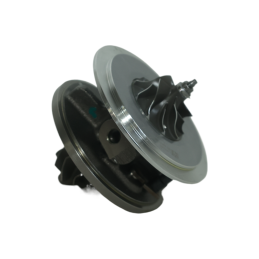
This hybrid turbo for diesel engines 1.9 out of 100 to 120 hp is available in three documented levels of preparation. Each course includes an MFS compressor wheel Performance with a 360° bearing stop and high-speed balancing on a Cimat VSR test bench.
The assignments identified relate in particular to Fiat Croma and Stilo, Opel Astra H, Signum, Vectra C and Zafira B, as well as the Saab 9-3. Compatibility must always be confirmed using the turbo’s part number d’origin’.
Available products — Stage 1, Stage 2 and Stage 2+
Stage 1
Compressor wheel: High-capacity MFS Performance
Dimensions: 34.70 / 49.00 mm
Blade configuration: 5+5
Bearing stop: 360°
Balancing: high speed at 150,000 rpm on a Cimat VSR test bench
This setup is based on an MFS wheel Performance designed for adjust the flow rate d’compressor air, whilst maintaining a Installation without modification documented. The result depends on the engine configuration and its settings.
Stage 2
Compressor wheel: High-capacity MFS oversized Performance
Dimensions: 38.62 / 52.00 mm
Blade configuration: 11+0
Carter d’Admission:’ reprofiled for to receive the wheel oversized
Bearing stop: 360°
Balancing: high speed at 150,000 rpm on a Cimat VSR test bench
The wheel oversized and the re-profiling of the casing d’admission requirements allow’ d’adapt the passage’ d’air with this geometry. This change may affect the flow rate and behaviour of the turbocharger depending on the conditions dUse.
Stage 2+
Compressor wheel: High-capacity MFS oversized Performance
Dimensions: 41.58 / 56.03 mm
Blade configuration: 7+7
Carter d’Admission:’ reprofiled for to receive the wheel oversized
Bearing stop: 360°
Balancing: high speed at 150,000 rpm on a Cimat VSR test bench
This course uses a larger impeller and a specific blade configuration. Its operation requires careful tuning of the engine management system and associated systems; however, the final power output cannot be deduced from these specifications alone.
What is a hybrid turbo ?
A hybrid turbo retains a turbocharger design that is suitable for accommodating modified internal components. Depending on the course, the preparation may cover the compressor wheel, its dimensions, the blade configuration and the casing d’intake, the stop system and balancing’.
The aim is d’adjust the compression capacity and flow rate’ dair. However, a hybrid turbo is not defined solely by the appearance of its impeller: the consistency between the geometry, the housings, the rotor and the engine management system remains crucial.
MFS compressor wheel: standard or Performance ? ?
MFS stands for ‘Milled From Solid’, meaning a wheel machined from a solid block. This designation describes the manufacturing process and does not, in itself, guarantee an increase in flow rate dair.
A standard MFS wheel can retain a geometry equivalent to that d’origin’. An MFS wheel Performance can be fitted with a blade geometry, diameter or configuration suited to the preparation objective.
A standard MFS wheel can be just as shiny as an MFS wheel Performance. It is not its appearance that determines its performance, but its geometry and its ability to move more dair. A higher flow rate can help to generate more power when the engine has been suitably tuned, although this does not in itself guarantee a power increase.
Why does the geometry of the blades affect the flow rate? d’air ?
The compressor wheel draws in and then compresses the air fed to the engine. Its diameter, profile, height, width and the arrangement of the blades influence its aerodynamic behaviour and its ability to move air within certain operating ranges.
The result also depends on the compressor housing, the turbine section, the boost pressure and the engine tuning. A larger wheel therefore does not automatically guarantee a better result and may affect the response time as well as the range doptimal use.
Reliability and balancing of the hybrid turbocharger
The 360° stop fitted to all three stages helps to distribute the axial forces applied to the rotor. It must operate with adequate lubrication and does not protect the turbocharger against faulty installation or insufficient oil supply.
Each preparation is balanced at high speed, up to 150,000 rpm, on a Cimat VSR test bench. The purpose of this balancing is to minimise vibrations and mechanical stresses on the rotor.
Engine remapping and tuning
The farm dA hybrid turbo may require adjustments to the engine mapping, boost pressure and wastegate settings. Depending on the level of preparation: fuel injection, exhaust, air cooling dThe intake system, clutch or gearbox must also be checked and, if necessary, adjusted by a professional.
Turbo part numbers
OEM part numbers
93183987
93183681
93178697
55190871
55188334
55193105
5860014
55196858
55196765
55195787
93192073
93184790
93169105
71791366
860129
860074
860073
860068
5860031
55205474
55205179
Manufacturer’s part numbers
740080-0002
740080-2
740080-2002
740080-5002S
752814-0001
752814-1
752814-2001
752814-5001S
755042-0001
755042-0003
755042-1
755042-2003
755042-3
755042-5002S
755042-5003S
755373-0001
755373-1
755373-2001
755373-5001S
767835-0001
767835-1
767835-2001
767835-5001S
767835-5003S
Compatible vehicles and assignments
Fiat
CROMA Estate Van (194_) LCV — 120 hp
Diesel — April 2006 to December 2011
Engine code : 939 A1.000
STILO (192_) PC — 120 hp
Diesel — September 2005 to November 2006
Engine code : 192 A8.000
STILO Multi Wagon (192_) PC — 120 hp
Diesel — September 2005 to August 2008
Engine code : 192 A8.000
Opel
ASTRA H (A04) PC — 100 hp
Diesel — September 2005 to October 2010
Engine code : Z 19 DTL
ASTRA H (A04) PC — 120 hp
Diesel — June 2004 to October 2010
Engine code : Z 19 DT
ASTRA H Estate (A04) PC — 100 hp
Diesel — September 2005 to October 2010
Engine code : Z 19 DTL
ASTRA H Estate (A04) PC — 120 hp
Diesel — September 2005 to October 2010
Engine code : Z 19 DT
ASTRA H Estate Van (L70) LCV — 101 hp
Diesel — August 2005 to December 2012
Engine code : Z 19 DTL
ASTRA H Estate Van (L70) LCV — 120 hp
Diesel — September 2005 to October 2010
Engine code : Z 19 DT
ASTRA H GTC (A04) PC — 101 hp
Diesel — January 2006 to October 2010
Engine code : Z 19 DTL
ASTRA H GTC (A04) PC — 120 hp
Diesel — September 2005 to October 2010
Engine code : Z 19 DT
SIGNUM Hatchback (Z03) PC — 100 hp
Diesel — August 2005 to February 2008
Engine code : Z 19 DTL
SIGNUM Hatchback (Z03) PC — 120 hp
Diesel — April 2004 to February 2008
Engine code : Z 19 DT
VECTRA C (Z02) PC — 100 hp
Diesel — October 2005 to August 2008
Engine code : Z 19 DTL
VECTRA C (Z02) PC — 120 hp
Diesel — April 2004 to January 2009
Engine code : Z 19 DT
VECTRA C Estate (Z02) PC — 100 hp
Diesel — June 2005 to August 2008
Engine code : Z 19 DTL
VECTRA C Estate (Z02) PC — 120 hp
Diesel — April 2004 to January 2009
Engine code : Z 19 DT
VECTRA C GTS (Z02) PC — 100 hp
Diesel — June 2005 to August 2008
Engine code : Z 19 DTL
VECTRA C GTS (Z02) PC — 120 hp
Diesel — April 2004 to January 2009
Engine code : Z 19 DT
ZAFIRA / ZAFIRA FAMILY B (A05) PC — 100 hp
Diesel — July 2005 to December 2010
Engine code : Z 19 DTL
ZAFIRA / ZAFIRA FAMILY B (A05) PC — 120 hp
Diesel — July 2005 to April 2015
Engine code : Z 19 DT
ZAFIRA B Box Body/MPV (A05) LCV — 120 hp
Diesel — July 2005 to April 2015
Engine code : Z 19 DT
Saab
9-3 (YS3F, E79, D79, D75) PC — 120 hp
Diesel — September 2004 to February 2015
Engine code : Z 19 DT
9-3 Convertible (YS3F) PC — 120 hp
Diesel — September 2004 to February 2015
Engine code : Z 19 DT
Additional technical specifications
Product type: hybrid turbo
Engine: 1.9 CDTI engines and documented diesel applications
Fuel: diesel
Documented power ratings: 100, 101 and 120 hp
Engine codes: 192 A8.000, 939 A1.000, Z 19 DT, Z 19 DTL
Periods covered: April 2004 to February 2015, depending on the assignment
Assembly instructions
⚠️ WARNING — IMPORTANT BEFORE ASSEMBLY
Identify and rectify the cause of the previous fault. Check the lubrication circuit, the supply and the return doil, as well as ensuring that all ducts are clean.
Check the intake and ensure there are no foreign objects. Carry out the priming in accordance with the relevant guidelines and follow the manufacturer’s instructions. The wastegate must be adjusted during installation and when configuring the engine management system.
If a lubrication fault is not rectified, it may lead to the turbocharger failing again.
How do you choose the right turbo ?
Check the turbo part number dStart by entering the OEM and manufacturer part numbers, then compare the make, model, generation, body style, engine type, power output, years of manufacture and engine code. The same engine can be fitted with several different turbo set-ups.
⚠️ Check your turbo’s part numbers
Before placing your order, Compare the part number on your turbocharger d’origin’ using the references given in this fact sheet. Having the same motor does not always guarantee compatibility.
If you’re unsure, please contact us with the reference number clearly visible on your turbo d’origin’.