


- Online only
Hybrid
Year: From 2006
Power: 102, 115 and 120 hp
displacement: 2.4 litres
Engine code: Not specified

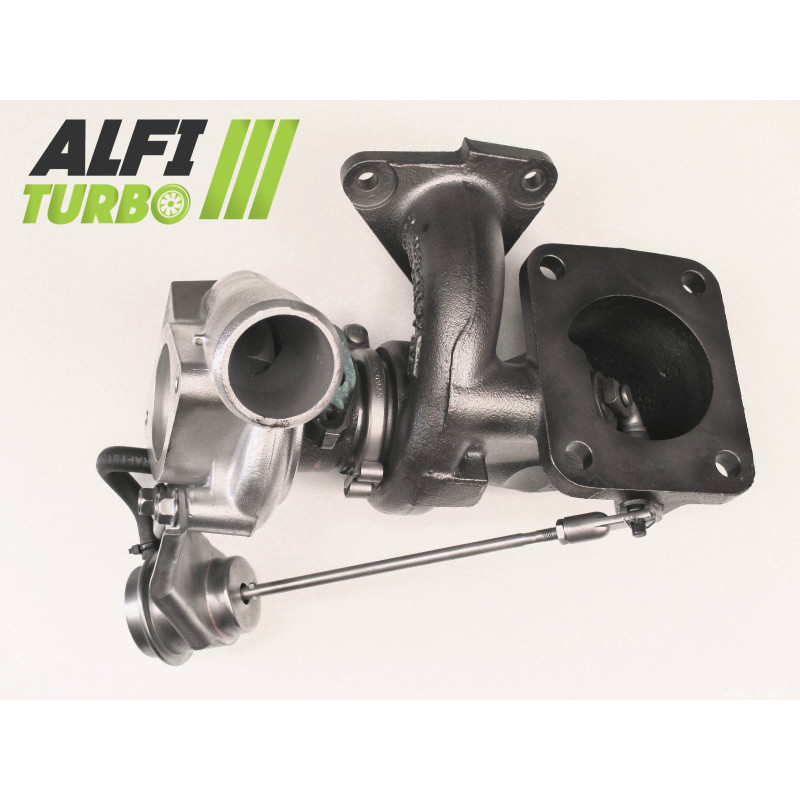
This hybrid turbo is designed for to provide compression capacity and flow rate d’air suitable for engine tuning. Depending on the package selected, it comes with a high-flow MFS compressor wheel, a 360° bearing retainer and, for the most advanced modifications, including re-profiling of the casings and a turbine wheel oversized.
The documented assignments include, in particular, the Ford Transit 2.4 TDCi, as well as several other models Citroën, , Fiat, , Ford and Peugeot. Compatibility must always be confirmed using the turbo’s part number d’origin’.
This preparation acts primarily on the compressor wheel in order to d’adjust the compression capacity and flow rate’ dair. The 360° stop helps to distribute the rotor’s axial forces more evenly.
The Stage 2 incorporates a compressor wheel oversized to a casing d’re-profiled intake’. This modification is designed to accommodate the new geometry correctly and to optimise airflow under the conditions specified in the set-up.
This modification affects the compressor and turbine sides. Oversizing can improve flow rate d’air, but it can also affect the response time and conditions dOptimal use of the turbocharger.
A hybrid turbo is based on a specially adapted turbocharger design for to receive internal components that differ from the configuration d’origin’. Depending on the service, the modifications may involve the compressor wheel, the turbine wheel, the casings, the thrust bearing system and the balancing of the rotor.
The aim is d’adjust the compression capacity and flow rate’ dair. However, a hybrid turbo is not defined solely by the appearance of its impeller: the geometry of its components and the overall coherence of the unit determine its performance.
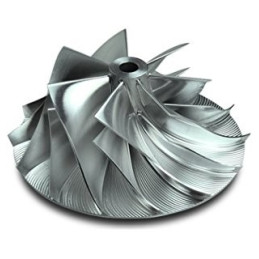
MFS stands for ‘Milled From Solid’, meaning a wheel machined from a solid block. This technology describes a manufacturing process and does not, in itself, guarantee an increase in throughput dair.
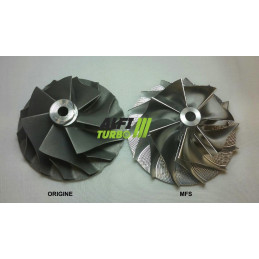
A standard MFS wheel can retain a geometry equivalent to the original. An MFS wheel Performance may be designed with a geometry suited to the application, with a different blade profile, height, width or diameter where such modifications are specified.
A standard MFS wheel can be just as shiny as an MFS wheel Performance. It is not its appearance that determines its performance, but its geometry and its ability to move more dair. The wheel described here is made from forged aluminium and features a lighter, larger and taller design than the one d’original; the technical data sheet states an additional compression capacity of 15 per cent.
The compressor wheel draws in and then compresses the air fed to the engine. Its diameter, profile, height, width and the arrangement of the blades all influence its aerodynamic behaviour. The result also depends on the casings, the turbine, the boost pressure and the engine tuning. A larger wheel therefore does not automatically guarantee a better result and may affect the response time.
The 360° bearing stop distributes the axial forces over a surface area suited to the rotor’s operation. It provides equipment for the three documented training courses.
High-speed balancing, carried out at 150,000 rpm on a Cimat VSR test bench, is designed to minimise vibrations and mechanical stresses. However, it does not protect the turbocharger against incorrect fitting, inadequate lubrication or the presence of da foreign body.
The farm dA hybrid turbo requires appropriate engine management. Mapping, boost pressure, fuel injection, the exhaust system, cooling and, depending on the vehicle, the transmission must be checked or adjusted. The wastegate must be adjusted when the ECU is remapped. Fitting the turbo alone does not guarantee a power increase.
⚠️ WARNING — IMPORTANT BEFORE ASSEMBLY
Before installation, identify and rectify the cause of the previous fault. Check the lubrication circuit, the supply and the return d’oil, as well as the cleanliness of the pipes. Check the intake and ensure there are no foreign objects present. Carry out the priming in accordance with the relevant guidelines and follow the manufacturer’s instructions. If a lubrication fault is not rectified, it may lead to the turbocharger failing again.
Check the part number marked on the turbocharger d’origin, OEM and manufacturer part numbers, as well as the make, model, generation, engine type, power output, theYear installation and engine code. The same engine can be fitted with several different turbo set-ups.
⚠️ Check your turbo’s part numbers
Before placing your order, Compare the part number on your turbocharger d’origin’ using the references given in this fact sheet. Having the same motor does not always guarantee compatibility.
If in doubt, please contact us, quoting the reference number clearly visible on your turbo’s nameplate d’origin’.

Reference: AM03-585
Brand: ALFI TURBO ///
Year: April 2006 to August 2014Power: 100 and 115 hpdisplacement: 2,402 cm³Engine code: Not specifiedWarranty: 2 years
ALFI TURBO specialises in the sale of turbochargers for for cars, commercial vehicles, heavy goods vehicles, construction machinery, agricultural machinery and boats: new turbochargers, remanufactured units, hybrid turbochargers, Cartridge and turbocharger spare parts. Over 20,000 items are available.
The turbocharger plays a vital role in the operation and performance d of a turbocharged engine. When a turbocharger needs replacing, it is important d to identify the exact part number before ordering.
ALFI TURBO supplies turbochargers for for a wide range of makes and engine types: cars, commercial vehicles, heavy goods vehicles, construction machinery, tractors and agricultural machinery, as well as various marine applications.
You can search for your turbo based on the vehicle or application, engine type, engine code, or directly using d an OEM or manufacturer part number found on your old turbocharger.
Browse our range of new turbochargers for for diesel and petrol engines. ALFI TURBO has over 5,500 new turbochargers in stock for covering a wide range of makes, engine types and turbocharger part numbers.
View new turbochargers →A standard exchange turbo allows you to replace a turbocharger whilst returning the old part where a deposit is required. Our catalogue includes numerous part numbers for from various makes and engine types.
View standard exchange turbochargers →Hybrid turbos are designed for set-ups requiring greater air flow d and higher performance potential than a standard set-up. Specifications depend on the turbo, its tuning and the engine configuration.
View hybrid turbos →The turbo Cartridge, also known as the central turbo cartridge, comprises the main rotating components of the turbocharger. ALFI TURBO has over 6,000 Cartridge for turbo part numbers.
View turbo Cartridge →Our catalogue covers a wide range of d applications fitted with d a turbocharged engine.
A single engine type may have been fitted with several different turbochargers depending on theYear, power output, engine version or technical evolution.. The application alone is therefore not always sufficient for to accurately identify the correct turbo.
Before ordering, note down the part numbers shown on the identification plate d of your old turbocharger. This may be d an OEM part number or d a part number from the turbo manufacturer.
Compare these part numbers with those listed on our product pages.. If in doubt, our team can help you verify the part number you are looking for before you place your order.
A loss of power, an unusual whistling noise, oil consumption d, abnormal smoke or poor engine performance may be linked to a turbocharger fault.
However, a fault that appears to be turbo-related may also stem d from a lubrication issue, d from contaminated oil, d from a foreign object, from the intake or exhaust systems, or d from another engine peripheral component.
It is therefore important to investigate the cause of the fault before fitting a new turbo or a new Cartridge.
Since 2012, ALFI TURBO has been assisting private individuals and professionals in identifying and replacing turbochargers.
A turbocharger failure may be the result d of another engine problem. Before fitting d a new turbo or Cartridge, identify and rectify the cause of the original fault to d avoid d damaging the new part.
Do you have a turbocharger part number but can’t find the matching part? Are you unsure which part number to choose? Send us the details from your old turbo so that our team can help you identify the part you’re looking for.
CONTACT ALFI TURBO
