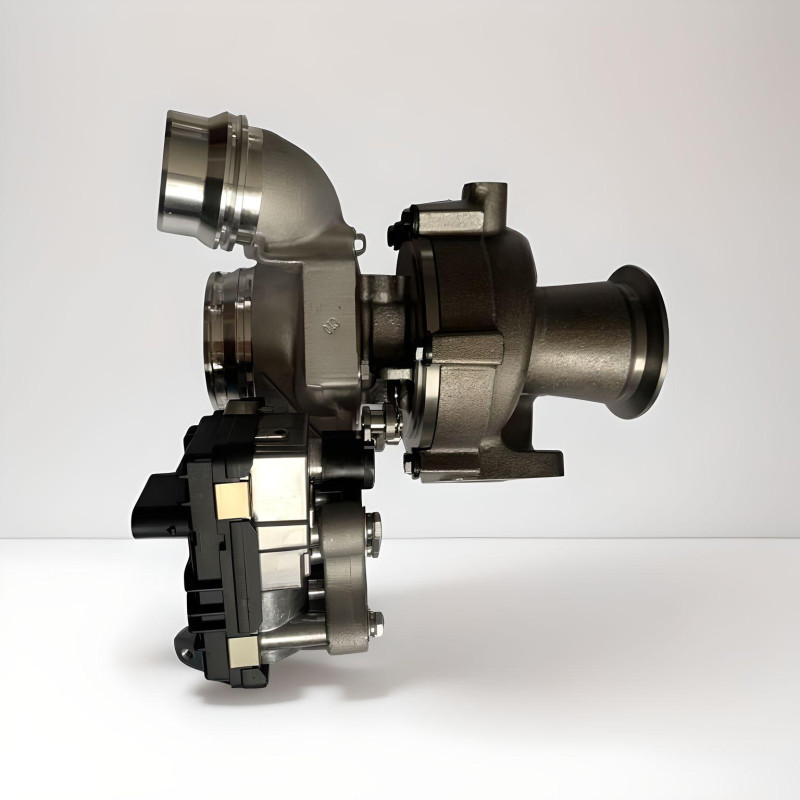
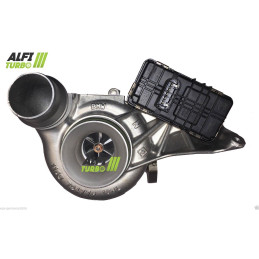
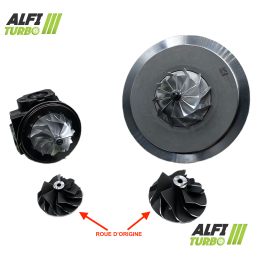
This plug & play hybrid turbocharger is designed for the documented Bmw 2.0 Diesel engines. The three tuning options available utilise a high-flow MFS Performance compressor wheel, a 360° bearing retainer and high-speed balancing.
The main applications are the Bmw 3 and 5 Series, as well as the X3. Compatibility must always be confirmed using the original turbo’s part number.
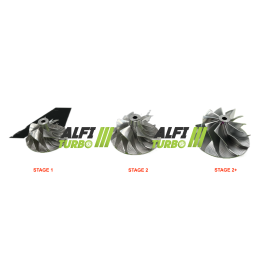
Available tuning packages — Stage 1, Stage 2 and Stage 2+
Stage 1
Compressor wheel: MFSPerformance high-flow
Dimensions: 38.00 / 51.00 mm
Blade configuration: 6+6
Bearing: 360° thrust
Balancing: 150,000 rpm on a Cimat VSR test bench
This modification alters the compressor wheel to adjust the air flow, whilst maintaining the advertised Installation without modification (no modifications required). Its performance depends on the engine’s settings and configuration.
Stage 2
Compressor wheel: MFS Performance, high-flow, oversized
Dimensions: 41.93 / 55.69 mm
Blade configuration: 11+0
Intake housing: re-profiled for the oversized impeller
Bearing: 360° thrust
Balancing: 150,000 rpm on a Cimat VSR test bench
The oversized impeller and the reprofiling of the inlet housing are designed to optimise compression capacity and airflow. This modification may also alter the turbocharger’s response depending on the engine configuration.
Stage 2+
Compressor wheel: MFS Performance, high-flow, oversized
Dimensions: 49.62 / 61.01 mm
Blade configuration: 11+0
Intake housing: re-profiled for the oversized impeller
Bearing: 360° thrust
Balancing: 150,000 rpm on a Cimat VSR test bench
This version features the largest compressor wheel documentedfor this product. Its design requires appropriate engine preparation and does not, on its own, guarantee a specific power output.
What is a hybrid turbo?
A hybrid turbo utilises a turbocharger architecture adapted for to accommodate modified internal components. Depending on the stage, the modifications may involve the compressor wheel, its geometry, its dimensions, the intake housing, the thrust bearing system and the balancing.
The aim is to optimise compression capacity and air flow. A hybrid turbo is not defined solely by the appearance of its impeller: the sizing, aerodynamics and overall coherence of the unit are essential.
MFS compressor wheel: standard or Performance?
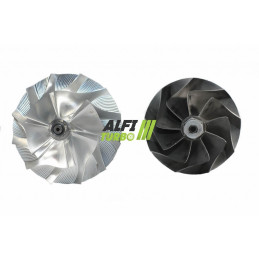
MFS stands for ‘Milled From Solid’, meaning a wheel machined from a solid block. This manufacturing process alone does not guarantee an increase in air flow. A standard MFS wheel may retain a geometry close to the original.
A standard MFS impeller can be just as effective as an MFS Performance impeller. It is not its appearance that determines its performance, but its geometry and its ability to move more air. A Performance impeller may feature a diameter, profile or blade configuration tailored to the vehicle’s tuning; increased airflow can only be utilised with appropriate engine management.
Why does blade geometry influence air flow?
The supercharger impeller draws in and then compresses the air sent to the engine. Its diameter, profile, height, width and blade arrangement all influence its aerodynamic behaviour. The result also depends on the compressor housing, the turbine section, the boost pressure and the engine tuning. A larger impeller therefore does not automatically guarantee better performance and may alter the response time.
Reliability and balancing of the hybrid turbo
The documented 360° thrust bearing helps to distribute axial forces. The rotor is balanced at high speeds, up to 150,000 rpm on a Cimat VSR test bench, in order to minimise vibrations and mechanical stresses. However, this balancing does not compensate for incorrect installation or inadequate lubrication.
Engine remapping and preparation
Operating a hybrid turbocharger requires appropriate engine management. Map settings, boost pressure, fuel injection, charge air cooling, the exhaust system and the transmission must be controlled in accordance with the level of tuning. The wastegate must be adjusted during the fitting and calibration of the ECU.
Turbo specifications
OEM part numbers
8506721
11658515187
11658512464
11657808758
8515188
8512465
8519477
851947703
851518702
851246405
851246404
851246403
780875802
780875801
11658519477
11658515188
11658512465
11658506721
11655A3B051
Manufacturer’s part numbers
49335-00511
49335-00500
49335-00510
49335-00520
49335-00530
49335-00550
49335-00560
49335-00570
49335-00583
49335-00521
49335-00531
49335-00561
49335-00581
49335-00582
49335-00584
49335-00585
Compatible vehicles and assignments
Bmw
3 (E90) — 184 hp
2.0-litre diesel — 03/2010 to 10/2011
Engine code: N47 D20 C
3 Convertible (E93) — 184 hp
2.0-litre diesel — March 2010 to October 2013
Engine code: N47 D20 C
3 Convertible (E93) — 200 hp
2.0-litre diesel — March 2010 to October 2013
Engine code: N47 D20 C
3 Coupé (E92) — 184 hp
2.0-litre diesel — March 2010 to June 2013
Engine code: N47 D20 C
3 Estate (E91) — 184 hp
2.0-litre diesel — March 2010 to May 2012
Engine code: N47 D20 C
3 Touring (E91) — 184 hp
2.0-litre diesel — March 2010 to June 2012
Engine code: N47 D20 C
5 (F10) — 184 hp
2.0-litre diesel — June 2010 to June 2014
Engine code: N47 D20 C
5 Touring (F11) — 184 hp
2.0-litre diesel — June 2010 to June 2014
Engine code: N47 D20 C
X3 (F25) — 163 hp
2.0-litre diesel — 09/2010 to 08/2017
Engine codes: N47 D20 C, B47 D20 A from 04/2014
X3 (F25) — 184 hp
2.0-litre diesel — 09/2010 to 03/2014
Engine code: N47 D20 C
Technical specifications
Product type: Turbo
Engine: Bmw 2.0-litre diesel
displacement: 2.0 L
Fuel: Diesel
Power outputs: 163, 184 and 200 hp
Engine codes: N47 D20 C, B47 D20 A
Documented production periods: 03/2010 to 08/2017 depending on the application
Fitting instructions
⚠️ WARNING — IMPORTANT BEFORE INSTALLATION
Identify and rectify the cause of the previous failure. Check the lubrication system, the oil supply and return lines, the cleanliness of the pipes, the intake and ensure there are no foreign objects present. Carry out the priming procedure in accordance with the applicable recommendations and follow the manufacturer’s instructions. An uncorrected lubrication fault may result in the turbocharger failing again.
How to identify the correct turbocharger?
Check the part number of the original turbocharger, the OEM and manufacturer part numbers, as well as the model, generation, body style, engine type, power output, production period and engine code. If in doubt, please contact us before ordering.
⚠️ Check your turbo’s part numbers
Before ordering, compare the part number on your original turbocharger with the part numbers listed in this specification sheet. An identical engine specification does not always guarantee compatibility.