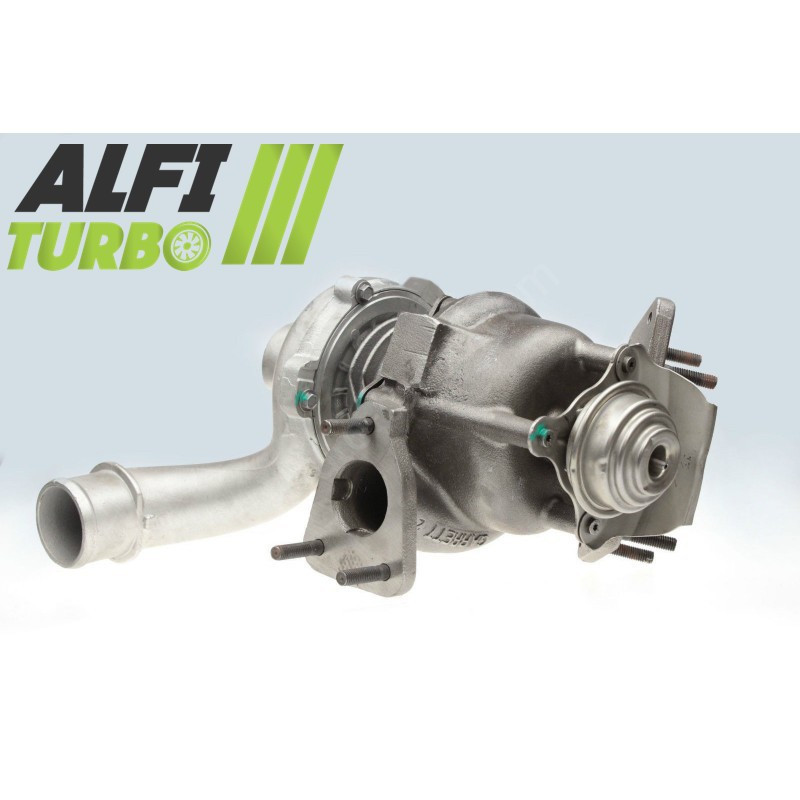
This hybrid turbo for, designed for the 2.2 dCi 130 engine, is available in three documented tuning levels.. Depending on the tuning package chosen, the modifications include the high-flow MFS compressor wheel, the casings and, for the Stage 3, the turbine section.
Its ‘ plug & play ’ type mounting requires no modification d to the. installation. The documented specification applies to the Renault Espace 3 from 2000 onwards.
Available preparations — Stage 1, Stage 2 and Stage 3
Stage 1
Compressor wheel: MFS high-flow
Thrust bearing: 360° bearing
Balancing: High-speed at 150,000 rpm on a Cimat VSR test bench
This configuration primarily enhances the compression capacity and air flow rate d thanks to the MFS compressor wheel, whilst retaining the original layout d of the system designed for for this turbocharger.
Stage 2
Compressor wheel: MFS high-flow oversized
d' intake housing: Reprofiled for accommodate the new impeller oversized
Thrust bearing: 360° bearing
Balancing: High-speed balancing at 150,000 rpm on a Cimat VSR test bench
The Stage 2 combines a oversized compressor impeller with a reprofiled d intake casing. This configuration is designed to adapt the air passage d to the impeller’s new geometry.
Stage 3
Compressor wheel: MFS high-flow oversized
Casing d'intake: Reprofiled for to accommodate the new impeller oversized
Thrust bearing: 360° bearing
Turbine impeller: High-flow oversized
Turbine housing: Reprofiled for ly to accommodate the new impeller oversized
Balancing: High-speed balancing at 150,000 rpm on a Cimat VSR test bench
Stage 3 modifies the compressor and turbine sides of the. The final performance depends on the overall engine preparation and the adaptation of the turbocharging management system.
Understanding hybrid tuning
What is a hybrid turbo?
A hybrid turbo utilises a turbocharger architecture adapted for accommodate modified internal components. Depending on the tuning stage, the modifications may involve the compressor wheel, the housings, the thrust bearing or the turbine section in order d to adjust the compression and air flow d.
The appearance of the impeller alone is not sufficient to define a hybrid modification: its geometry, its combination with the casings and the overall balance of the assembly are also decisive.
MFS compressor impeller: standard or Performance?
MFS stands for ‘Milled From Solid’, meaning a wheel machined from a solid block. This technology describes the manufacturing process and does not, on its own, guarantee an increase in flow rate. A standard MFS wheel may retain a geometry close to the original.
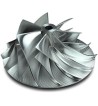
On this product, the wheel shown is made from forged aluminium; it is lighter, larger and taller than the original d. Depending on the upgrade, it is available in either a high-flow or high-flow version oversized.
A standard MFS impeller can be just as shiny as an MFS impeller Performance. It is not its appearance that determines its performance, but its geometry and its ability to move more d'air.
Why does the geometry of the blades influence the d air flow?
The impeller’s diameter, profile, height, width and blade arrangement all influence the intake and compression of air. The right geometry can move more d'air under certain conditions, but the result also depends on the housings, the turbine, the boost pressure and the mapping. A larger impeller therefore does not automatically guarantee better performance and may alter the response time.
Reliability and balancing of the hybrid turbocharger
The documented 360° bearing stop helps to distribute axial forces. Balancing the rotor at 150,000 rpm on a Cimat VSR test bench aims to limit vibrations and mechanical stresses, without compensating for any faults in assembly or lubrication.
Engine remapping and preparation
Appropriate engine management is required for to make the most of the hybrid turbo’s characteristics. The mapping, boost pressure and wastegate adjustment must be checked during remapping. Depending on the tuning, the fuel injection, exhaust, cooling and transmission may also require checking or adjustment. No power gain is automatic without a coherent configuration.
Turbo specifications
OEM part numbers
7701474413
8.200.052.297
8200052297
Manufacturer part numbers
701164-0002
725071-0002
Compatible vehicles and applications
Renault
Espace 3 — 2.2 dCi 130 hp
Engine variants 2.2 dCi — from 2000, end date unspecified
Engine code: not specified
Additional technical specifications
Product type: Hybrid Turbo
Partnumber: 701164
Engine: 2-.2- dCi
Power: 130 hp
Documented period: From 2000
Installation: Plug & play, no modifications required
Installation advice
⚠️ WARNING — IMPORTANT BEFORE INSTALLATION
Identify and rectify the cause of the previous fault before d installing the turbo. Check the lubrication circuit, the oil supply and return d as well as the cleanliness of the pipes.
Check the intake for any foreign objects. Prime the system in accordance with the applicable recommendations and follow the manufacturer’s instructions.
A lubrication fault that is not rectified may lead to further damage to the turbocharger.
How do you identify the correct turbo?
Check the part number marked on the original turbo d and compare it with the OEM and manufacturer part numbers in this data sheet. Also check the make, model, generation, engine type, power output, mountingYear and engine code where available.
An identical engine specification does not always guarantee compatibility, as there may be several different mounting configurations.
⚠️ Check your turbo’s part numbers
Before ordering, compare the part number marked on your original turbo d with the part numbers listed in this data sheet. An identical engine specification does not always guarantee compatibility.
If you are unsure about the identification or the level of modification, please contact us with the full part number of the original turbo d.