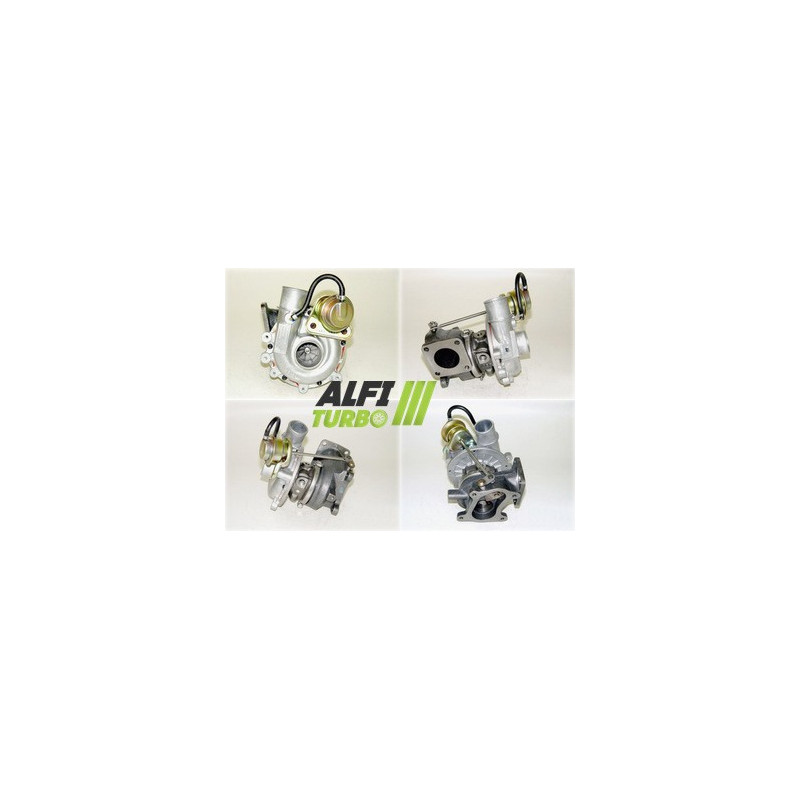
This hybrid turbo for engine 2.5 TD of 109 hp benefits from d'an internal mechanism designed to adjust its compression capacity and flow rate' d'air'. Depending on the service package chosen, it receives a high-flow MFS compressor wheel, a casing re-profiling or a modification to the turbine section.
Its release has been announced plug & play on compatible apps Ford and Mazda listed below. However, using this preparation requires appropriate engine and peripheral adjustments.
Available products — Stage 1, Stage 2 and Stage 3
Stage 1
Compressor wheel: High-capacity MFS
Stop: 360°
Balancing: high speed at 150,000 rpm on a Cimat VSR test bench
This preparation acts primarily on the compressor wheel in order to d'adjust the flow rate' d'air, whilst retaining a configuration suitable for the intended installation'.
Stage 2
Compressor wheel: High-capacity MFS oversized
Carter d'Admission:' reprofiled for to receive the new wheel oversized
Stop: 360°
Balancing: high speed at 150,000 rpm on a Cimat VSR test bench
Reprofiling the casing allows d'fit the compressor wheel' oversized. This configuration can move more d'air, but its behaviour depends on the settings and associated equipment'.
Stage 3
Compressor wheel: High-capacity MFS oversized
Carter d'Admission:' reprofiled for to receive the new wheel oversized
Stop: 360°
Turbine wheel: high-speed oversized
Turbine casing: reprofiled for to receive the new wheel oversized
Balancing: high speed at 150,000 rpm on a Cimat VSR test bench
This procedure applies to the compressor and turbine sides. The oversized wheels and re-profiled housings alter the flow capacity and the response characteristics of the turbocharger.
What is a hybrid turbo ?
A hybrid turbo uses a specially adapted turbocharger design for to receive internal components that differ from the configuration d'origin'. Depending on the course, the modifications may involve the compressor wheel, the casings, the turbine wheel, the thrust bearing and balancing.
The aim is d'adjust the compression and bitrate' d'air'. A hybrid turbo is not defined solely by the appearance of its impeller: its geometry, machining and the overall coherence of the unit are crucial.
MFS compressor wheel: standard or Performance ? ?
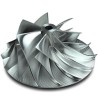
MFS stands for ‘Milled From Solid’, meaning a wheel machined from a solid block. This manufacturing process alone does not guarantee a higher flow rate. A standard MFS wheel can retain a geometry close to its original state.
An MFS wheel Performance adopts a geometry suited to the intended purpose. On this product, the wheel shown is made from forged aluminium and features a design that is lighter, larger and taller than the one d'origin, as announced' for 15 per cent additional compression.
A standard MFS wheel can be just as shiny as an MFS wheel Performance. It is not its appearance that determines its performance, but its geometry and its ability to move more d'air'. Higher power output can only be fully utilised with appropriate engine tuning.
Why does the geometry of the blades affect the flow rate? d'air?' ?
The compressor wheel draws in and then compresses the air fed to the engine. Its diameter, profile, height, width and the arrangement of its blades all influence its aerodynamic behaviour.
The result also depends on the casings, the turbine wheel, the boost pressure and the engine management system. A larger wheel therefore does not automatically guarantee a better result and may affect the response time as well as the range d'optimal use'.
Reliability and balancing of the hybrid turbocharger
The 360° stop fitted to each stage helps to distribute the axial forces to which the rotating assembly is subjected. It does not exempt d'a lubrication system in perfect working order, nor' d'a compliant assembly'.
High-speed balancing at 150,000 rpm on a Cimat VSR test bench is designed to minimise vibrations and mechanical stresses on the rotor. It does not protect against a fault d'oil, contamination or an error' d'installation'.
Engine remapping and tuning
The engine mapping needs to be adjusted for make the most of the hybrid turbo’s features. The wastegate must be adjusted when the ECU is remapped.
Depending on the level of preparation, it is also advisable to check or d'adjust the fuel injection, exhaust system, cooling system, boost pressure management and other components under load'. The hybrid turbo alone does not guarantee a power boost.
Turbo part numbers
OEM part numbers
3608377
3892427
3M35-9G438-AA
3M35-9G438-AB
3M35-9G438-AC
3M359G438AA
3M359G438AB
3M359G438AC
4155051
4573957
4945478
MF7J13700D
MS7J13700D
WL11.13.700
WL1113700
WL84
WL84.13.700
WL8413700A
WL8417300B
WL85
WL8513700
WL8513700A
WL8513700C
XM34-9G348-AA
XM34-9G438-AC
XM349G348AA
XM349G438AC
XN349G348AB
Manufacturer’s part numbers
RHF5VJ26
RHF5VJ33
VA430013
VA430089
VA430090
VB40013
VB430013
VB430089
VB430090
VC430013
VC430089
VC430090
VD430013
VD430090
VE430090
VI430089
VJ26
VJ26E
VJ33
Compatible vehicles and assignments
Ford
Courier 2.5 TD — 109 hp
2.5 TD — from 2000, end date unspecified
Engine code : not specified
Ranger 2.5 TD — 109 hp
2.5 TD — from 1999, end date unspecified
Engine code : not specified
Ranger 2 2.5 TD 4WD — 109 hp
2.5 TD 4WD — from 2002, end date unspecified
Engine code : not specified
Ranger Double Cab 2.5 TD — 109 hp
2.5 TD — from 2000, end date unspecified
Engine code : not specified
Mazda
B 2500 2.5 TD — 109 hp
2.5 TD — from 1996, end date unspecified
Engine code : not specified
B Pickup 2.5 TD — 109 hp
2.5 TD — from 1999, end date unspecified
Engine code : not specified
Additional technical specifications
Product type: Hybrid Turbo
Engine: 2.5 TD
Power : 109 hp
Engine codes: Not specified
Editing: plug & play, without any changes to compatible applications
Assembly instructions
⚠️ WARNING — IMPORTANT BEFORE ASSEMBLY
Before carrying out any installation, investigate and rectify the cause of the previous turbocharger’s failure.
Check the lubrication circuit, the supply and the return d'oil'. Ducts must be clean, unobstructed and properly ventilated.
Check the intake and exhaust systems and ensure there are no foreign objects present. Carry out the priming in accordance with the relevant guidelines and follow the manufacturer’s instructions.
If a lubrication fault is not rectified, it may lead to the turbocharger failing again.
How do you choose the right turbo ?
Compare the turbo part number d'Original, with the OEM and manufacturer’s reference numbers for this data sheet'. Also check the make, model, generation, body style, engine type and power output of 109 hp, theYear installation details and, where available, the engine code.
The same engine can be fitted with several different turbocharger set-ups. The reference number engraved on the plate or the turbo housing is therefore a key component d'Identification'.
⚠️ Check your turbo’s part numbers
Before placing your order, Compare the part number on your turbocharger d'origin' using the references given in this fact sheet. Having the same motor does not always guarantee compatibility.
If you are in any doubt, please contact us with the full reference number of your turbocharger d'Your vehicle's origin and details'.