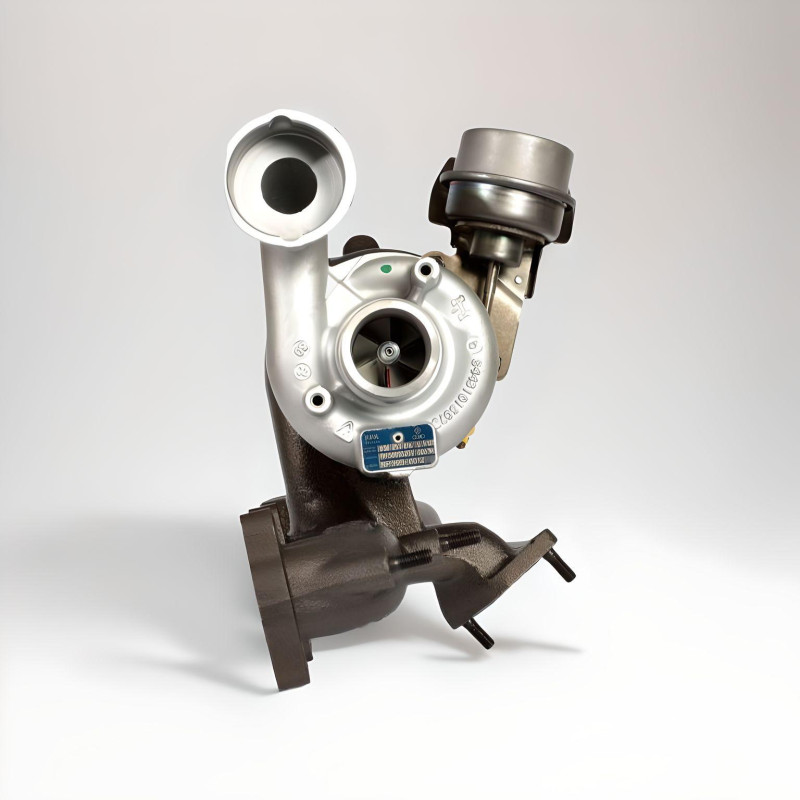
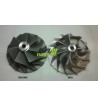
This hybrid turbo for engine variants 1.9 TDI is available in three levels of preparation. Depending on the model selected, its configuration combines a high-flow MFS compressor wheel, a 360° bearing stop and internal modifications designed to adjust the flow rate dair.
The documented applications relate in particular to certain models Ford, , Seat, , Skoda and Volkswagen producing 130 or 150 hp. Compatibility must be confirmed using the turbocharger part number d’origin’.
Available products — Stage 1, Stage 2 and Stage 3
Stage 1
Compressor wheel: High-capacity MFS
Stop system: 360° thrust bearing
Balancing: High speed at 150,000 rpm on a Cimat VSR test bench
This preparation acts primarily on the compressor wheel in order to d’adjust the compression capacity and flow rate’ dair. Its performance depends on the engine configuration and the turbocharging system.
Stage 2
Compressor wheel: High-capacity MFS oversized
Carter d’Admission:’ Reprofiled for to receive the new wheel oversized
Stop system: 360° thrust bearing
Balancing: High speed at 150,000 rpm on a Cimat VSR test bench
Reprofiling the casing allows d’adjust the gear to the drive wheel’ oversized. This configuration may affect the available flow rate and the behaviour of the compressor, depending on the conditions dUse.
Stage 3
Compressor wheel: High-capacity MFS oversized
Carter d’Admission:’ Reprofiled for to receive the new wheel oversized
Stop system: 360° thrust bearing
Turbine wheel: High flow rate oversized
Turbine casing: Reprofiled for to receive the new wheel oversized
Balancing: High speed at 150,000 rpm on a Cimat VSR test bench
This procedure is carried out on the compressor and turbine sides. The oversized wheels and re-profiled casings are designed to optimise air and gas flow, although they do not, on their own, guarantee the final power output.
What is a hybrid turbo ?
A hybrid turbo is based on a specially adapted turbocharger design for to receive internal components that differ from the configuration d’origin’. Depending on the course, the preparation may involve the compressor wheel, the turbine wheel, the casings, the thrust bearing system or balancing.
The aim is d’adjust the compression capacity and flow rate’ dair. However, a hybrid turbo is not defined solely by the appearance of its impeller: the geometry of the components and the way they are combined are crucial.
MFS compressor wheel: standard or Performance ? ?
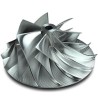
MFS stands for ‘Milled From Solid’, meaning a wheel machined from a solid block. This manufacturing process does not, on its own, guarantee an increase in throughput dair. A standard MFS wheel can retain a geometry equivalent to that d’origin’.
An MFS wheel Performance can be configured with a geometry suited to the preparation objective, for example a specific profile or dimensions, where these details are documented. A standard MFS wheel can be just as shiny as an MFS wheel Performance. It is not its appearance that determines its performance, but its geometry and its ability to move more dair. Higher power output can only be utilised properly with appropriate engine tuning.
Why does the geometry of the blades affect the flow rate? d’air ?
The compressor wheel draws in and then compresses the air fed to the engine. Its diameter, profile, height, width and the arrangement of its blades all influence its aerodynamic behaviour. The right geometry can move more d’air within certain operating ranges, but the result also depends on the casings, the turbine wheel, the boost pressure and the mapping. A larger wheel therefore does not automatically guarantee better performance and may affect response time.
Reliability and balancing of the hybrid turbocharger
The 360° stop, as documented in the three training courses, distributes the axial forces around the bearing. The rotor benefits from d’high-speed balancing at 150,000 rpm on a Cimat VSR test bench in order to minimise vibrations and mechanical stresses’. However, this balancing does not compensate for either incorrect installation or inadequate lubrication.
Engine remapping and tuning
The farm dA hybrid turbo requires appropriate engine management. Mapping, boost pressure, fuel injection, exhaust and cooling must be checked or adjusted depending on the engine modification. The clutch, gearbox and other vehicle components may also need to be checked. The wastegate must be adjusted when remapping the ECU. No increase in power is automatic without proper configuration.
Turbo part numbers
OEM part numbers
038253010E
038253010EV
038253010EX
038253010Q
038253010T
038253010TX
038253016S
038253056F
038253056FX
038253056H
038253056HV
038253056HX
038253014C
038253014CV
038253014CX
038253016SV
038253016SX
Manufacturer’s part numbers
54399700012
54399700023
54399800012
54399800023
54399880012
54399880023
54399900012
54399900023
Compatible vehicles and assignments
Ford
Galaxy 1 Phase 2 — 130 hp
1.9 TDI — from 2000, end date unspecified
Engine code : not specified
Galaxy 1 Phase 2 — 150 hp
1.9 TDI — from 2000, end date unspecified
Engine code : not specified
Seat
Alhambra 2 — 130 hp
1.9 D — from 2000, end date unspecified
Engine code : not specified
Alhambra 2 Phase 2 — 130 hp
1.9 TDI — from 2003, end date not specified
Engine code : not specified
Alhambra 2 Phase 2 — 150 hp
1.9 TDI — from 2003, end date not specified
Engine code : not specified
Córdoba 4 — 130 hp
1.9 TDI — from 2002, end date unspecified
Engine code : not specified
Ibiza 3 — 130 hp
1.9 TDI — from 2001, end date unspecified
Engine code : not specified
Ibiza 4 — 130 hp
1.9 TDI — from 2001, end date unspecified
Engine code : not specified
Leon — 130 hp
1.9 TDI — from 1999, end date unspecified
Engine code : not specified
Toledo Series 2 — 130 hp
1.9 TDI — from 1998, end date unspecified
Engine code : not specified
Skoda
Fabia — 130 hp
1.9 TDI — from 1999, end date unspecified
Engine code : not specified
Fabia Phase 2 — 130 hp
1.9 TDI — from 2004, end date unspecified
Engine code : not specified
Volkswagen
Polo 7 — 130 hp
1.9 TDI — from 2001, end date unspecified
Engine code : not specified
Polo 8 — 130 hp
1.9 TDI — from 2005, end date unspecified
Engine code : not specified
Sharan — 130 hp
1.9 TDI — from 2000, end date unspecified
Engine code : not specified
Sharan 2 — 150 hp
1.9 TDI — from 2000, end date unspecified
Engine code : not specified
Additional technical specifications
Product type: Hybrid Turbo
Engine: 1.9 TDI, with one allocation.9 D documented
displacement : 1.9 l
Documented power ratings: 130 hp and 150 hp
Documented periods: From 1998 onwards, depending on the application; purposes not specified
Installation: Configuration plug & play, with no documented external changes
Assembly instructions
⚠️ WARNING — IMPORTANT BEFORE ASSEMBLY
Identify and rectify the cause of the previous fault. Check the lubrication circuit, as well as the supply and return lines doil. Check that the ducts and the intake are clean and free from foreign objects. Carry out the priming in accordance with the relevant guidelines and follow the manufacturer’s instructions. If a lubrication fault is not rectified, it may lead to the turbocharger failing again.
How do you choose the right turbo ?
Check the part number marked on the turbocharger dthe original, then compare the OEM and manufacturer part numbers. Also check the make, model, generation, engine type and power output in hp, theYear the mounting code and the engine code, where available. Having the same motor does not always guarantee compatibility.
⚠️ Check your turbo’s part numbers
Before placing your order, Compare the part number on your turbocharger d’origin’ using the references given in this fact sheet. Having the same motor does not always guarantee compatibility.
If you are in any doubt, please contact us with the full part number from your turbocharger.