
- Hybrid
ALFI ref.: HYB-M04-303
RENAULT MEGANE II (BM0/1_, CM0/1_) 2.0 / 2.0 16V Turbo / 2.0 Renault Sport • 163 / 224 / 230 HP

1998 cm³ · Essence
Source: TecDoc / TecAlliance
Check the OEM reference of your original turbo before buying: the model alone does not guarantee fitment.
| Manufacturer | Model | Type | Years | Power | Displacement | Engine code |
|---|---|---|---|---|---|---|
| RENAULT | AVANTIME (DE0_) | 2.0 16V Turbo (DE0U, DE0V) | 11/2001 – 05/2003 | 163 HP / 120 kW | 1998 cm³ | F4R 761, F4R 760 |
| RENAULT | ESPACE IV (JK0/1_) | 2.0 Turbo (JK0A, JK0B, JK0N) | 11/2002 – 02/2006 | 163 HP / 120 kW | 1998 cm³ | F4R 797, F4R 794, F4R 795, F4R 796 |
| RENAULT | GRAND SCÉNIC II (JM0/1_) | 2.0 | 04/2004 – 06/2009 | 163 HP / 120 kW | 1998 cm³ | F4R 776 |
| RENAULT | LAGUNA Coupé (DT0/1) | 2.0 16V Turbo | 09/2008 – 12/2015 | 170 HP / 125 kW | 1998 cm³ | F4Rt 811, F4R 811 |
| RENAULT | LAGUNA Coupé (DT0/1) | 2.0 GT | 09/2008 – 12/2015 | 204 HP / 150 kW | 1998 cm³ | F4R 800 |
| RENAULT | LAGUNA II (BG0/1_) | 2.0 16V (BG03, BG0Z, BG0T, BG1Y) | 01/2005 – 09/2007 | 170 HP / 125 kW | 1998 cm³ | F4R 784, F4R 786, F4R 787 |
| RENAULT | LAGUNA II (BG0/1_) | 2.0 16V Turbo (BG0S, BG1L, BG1M) | 01/2003 – 03/2005 | 163 HP / 120 kW | 1998 cm³ | F4R 764, F4R 765 |
| RENAULT | LAGUNA II Grandtour (KG0/1_) | 2.0 16V (KG03, KG0Z, KG0T, KG1Y) | 01/2005 – 09/2007 | 170 HP / 125 kW | 1998 cm³ | F4R 784, F4R 786, F4R 787 |
| RENAULT | LAGUNA II Grandtour (KG0/1_) | 2.0 16V Turbo (KG0S, KG1L, KG03) | 01/2003 – 08/2005 | 163 HP / 120 kW | 1998 cm³ | F4R 764, F4R 765 |
| RENAULT | LAGUNA III (BT0/1) | 2.0 16V Turbo | 10/2007 – 12/2015 | 170 HP / 125 kW | 1998 cm³ | F4R 811 |
| RENAULT | LAGUNA III (BT0/1) | 2.0 GT | 03/2008 – 12/2015 | 204 HP / 150 kW | 1998 cm³ | F4R 800 |
| RENAULT | LAGUNA III Grandtour (KT0/1) | 2.0 16V Turbo | 10/2007 – 12/2015 | 170 HP / 125 kW | 1998 cm³ | F4R 811 |
| RENAULT | LAGUNA III Grandtour (KT0/1) | 2.0 GT | 03/2008 – 12/2015 | 204 HP / 150 kW | 1998 cm³ | F4R 800 |
| RENAULT | MEGANE II (BM0/1_, CM0/1_) | 2.0 | 08/2006 – 02/2008 | 230 HP / 169 kW | 1998 cm³ | F4R 774 |
| RENAULT | MEGANE II (BM0/1_, CM0/1_) | 2.0 16V Turbo | 05/2004 – 02/2008 | 163 HP / 120 kW | 1998 cm³ | F4R 776 |
| RENAULT | MEGANE II (BM0/1_, CM0/1_) | 2.0 Renault Sport | 05/2004 – 10/2009 | 224 HP / 165 kW | 1998 cm³ | F4Rt 774, F4R 774 |
| RENAULT | MEGANE II Coupé-Cabriolet (EM0/1_) | 2.0 16V Turbo | 05/2004 – 03/2009 | 163 HP / 120 kW | 1998 cm³ | F4R 776 |
| RENAULT | SCÉNIC II (JM0/1_) | 2.0 16V Turbo (JM0W) | 05/2004 – 11/2008 | 163 HP / 120 kW | 1998 cm³ | F4R 776 |
| RENAULT | VEL SATIS (BJ0_) | 2.0 16 V Turbo | 04/2004 – 08/2009 | 170 HP / 125 kW | 1998 cm³ | F4R 766, F4R 767 |
| RENAULT | VEL SATIS (BJ0_) | 2.0 16V Turbo (BJ0K) | 06/2002 – 08/2009 | 163 HP / 120 kW | 1998 cm³ | F4R 763, F4R 762 |
Source: TecDoc / TecAlliance
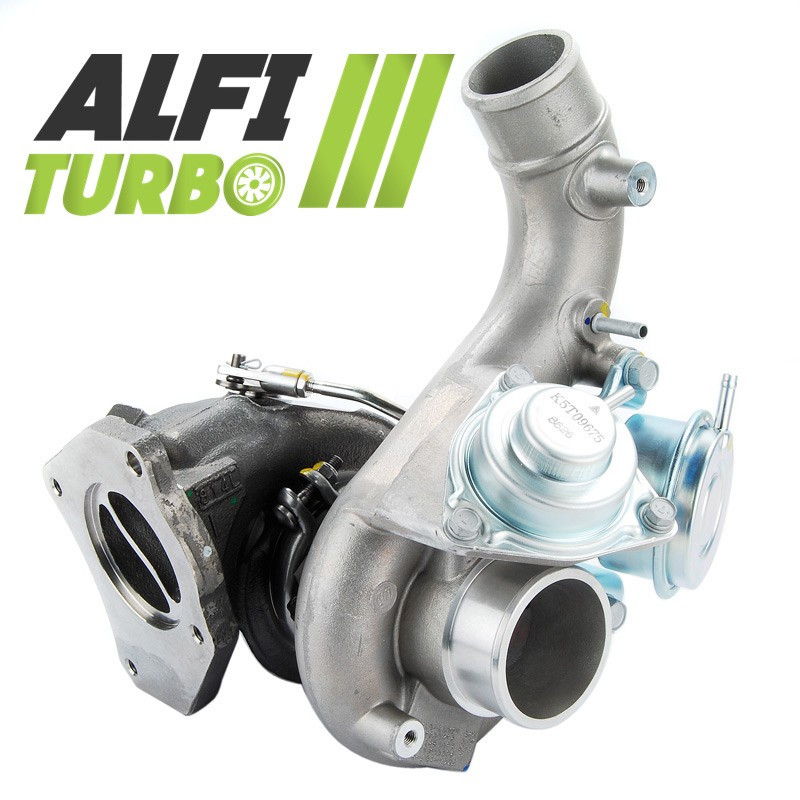
This TD04 hybrid turbocharger is designed for the 2.0 i engines with 165, 170 and 180 hp, corresponding to the part numbers listed on this data sheet:.. Its tuning is based on a high-flow MFS compressor wheel, a 360° bearing stop and high-speed balancing.
The available tuning levels allow you to choose different internal configurations whilst retaining a plug & play-style installation, with no external modifications required as per the product specification.
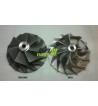
This modification primarily affects the compressor section in order d to adjust the compression capacity and the d air flow rate of the turbo.
The reprofiling of the intake d housing accompanies the change in diameter of the. compressor wheel. This configuration may alter the available flow rate and the behaviour of the turbocharger.
This modification involves changes to both the compressor and turbine sides. The larger dimensions may affect air flow d, exhaust flow d and response time, depending on the engine configuration.
A hybrid turbo retains an architecture suited to the intended installation whilst incorporating internal modifications. Depending on the upgrade stage, these may involve the compressor wheel, the housings, the turbine wheel, the thrust bearing or balancing.
The aim is d to adapt the compression capacity and the air flow rate d. However, a hybrid turbo is not defined solely by the appearance of its impeller: the overall geometry and the consistency between the components determine its behaviour.
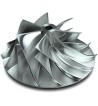
MFS stands for ‘Milled From Solid’, meaning a wheel machined from a solid block. This technology describes its manufacturing process and does not, on its own, guarantee an increase in airflow d.
A standard MFS impeller may retain a geometry equivalent to that of the original d. An MFS Performance impeller is based on a geometry adapted to the tuning objective, for example in terms of the profile, height, width or diameter of the blades where such modifications are intended.
A standard MFS impeller can be just as polished as an MFS impeller Performance. It is not its appearance that determines its performance, but its geometry and its ability to move more d'air. A higher airflow can support an increase in power with a suitably adapted engine tuning, though this alone does not guarantee results.
The compressor impeller draws in and then compresses the air sent to the engine. Its diameter, profile, height, width and blade arrangement all influence its aerodynamic behaviour. The result also depends on the housing, the turbine, the boost pressure and the engine tuning. A larger impeller therefore does not automatically guarantee a better result and may alter the response time.
The documented 360° bearing stop helps to distribute axial forces around the assembly. It does not, however, eliminate the need for d a compliant lubrication system or d careful installation.
The rotor is balanced at high speed, up to 150,000 rpm, on a Cimat VSR test bench. This process aims to minimise vibrations and mechanical stresses, but does not protect against incorrect installation, inadequate lubrication or the presence d of a foreign object.
The engine control unit must be remapped for to make full use of the performance upgrade’s characteristics. The mapping, boost pressure, fuel injection, exhaust and cooling must be checked or adjusted according to the vehicle. The wastegate must be adjusted during remapping. The transmission and other components under load must also be checked depending on the project.
No detailed list of makes, models, production periods or engine codes is documented. Compatibility must be confirmed using the reference number on the original turbo d.
⚠️ WARNING — IMPORTANT BEFORE INSTALLATION
Identify and rectify the cause of the previous fault. Check the lubrication circuit, as well as the oil supply and return d. Check that the pipes and the inlet are clean and free from foreign objects.
Carry out priming in accordance with the applicable recommendations and follow the manufacturer’s instructions. The mapping and adjustment of the wastegate must be carried out by a qualified professional.
Unresolved lubrication issues may lead to further turbocharger failure.
Check the part number of the original turbo d and compare it with the OEM and manufacturer part numbers in this fact sheet. Also check the model, generation, body style, engine type, power output, years of manufacture and engine code where available. An identical engine type is not always sufficient to confirm compatibility.
⚠️ Check your turbo’s part numbers
Before ordering, compare the part number marked on your original turbo d with the part numbers listed in this data sheet. An identical engine specification does not always guarantee compatibility.
If in doubt, please contact us with a clear photo of the nameplate or the part number of the original turbo d.
Download
WARNING — IMPORTANT BEFORE INSTALLATION
Before fitting, identify and rectify the cause of the previous fault. Check the lubrication circuit, the oil supply and return d as well as the cleanliness of all pipes.
Check the inlet for any foreign objects. Prime the system in accordance with the applicable recommendations and follow the vehicle manufacturer’s instructions.
A lubrication fault that is not rectified may lead to further damage to the turbocharger.
Check the part number of the original turbo d, the OEM and manufacturer part numbers, then compare the make, model, generation, body style, engine type, power output, production period and engine code.. An identical engine type may have several different configurations.
Check your turbo’s part numbers
Before ordering, compare the part number marked on your original turbo d with the part numbers listed in this specification sheet. An identical engine does not always guarantee compatibility.
If in doubt, please contact us with the part number clearly visible on your turbo and the vehicle’s precise details.

check_circle
check_circle