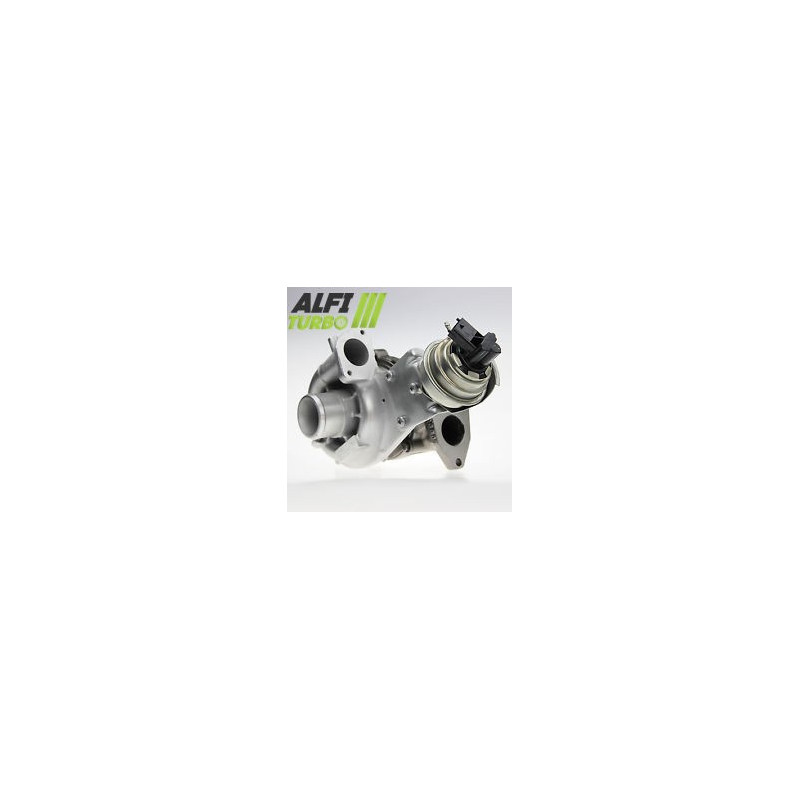
This hybrid turbocharger is designed for 1-litre engines.6 D / JTD between 116 and 120 hp combines an installation plug & play internal preparation tailored to the selected course. The documented configurations use a high-flow MFS compressor wheel, a 360° bearing retainer and high-speed balancing.
The applications listed relate in particular to Fiat Idea and Punto EVO, as well as the Lancia Delta III and Musa fitted with engine 1.6 Multijet.
Available products — Stage 1, Stage 2 and Stage 3
Stage 1
Compressor wheel: High-capacity MFS
Stop system: 360° bearing stop
Balancing: high speed at 150,000 rpm on a Cimat VSR test bench
This preparation acts primarily on the compressor wheel in order to d'adjust the compression capacity and flow rate' d'air'. The 360° stop helps to distribute the rotor’s axial forces more evenly.
Stage 2
Compressor wheel: High-capacity MFS oversized
Carter d'Admission:' reprofiled for to receive the new wheel oversized
Stop system: 360° bearing stop
Balancing: high speed at 150,000 rpm on a Cimat VSR test bench
The Stage 2 incorporates a compressor wheel oversized to a casing d're-profiled intake'. This modification is designed to accommodate the new geometry correctly and may affect the flow rate d'air flow and the turbocharger’s response'.
Stage 3
Compressor wheel: High-capacity MFS oversized
Carter d'Admission:' reprofiled for to receive the new wheel oversized
Turbine wheel: high-speed oversized
Turbine casing: reprofiled for to receive the new wheel oversized
Stop system: 360° bearing stop
Balancing: high speed at 150,000 rpm on a Cimat VSR test bench
This configuration includes modifications to the compressor and turbine sides. The reshaping of the two casings allows for the fitting of oversized wheels, with the resulting performance depending on the engine management system and the overall mechanical configuration.
What is a hybrid turbo ?
A hybrid turbo utilises a suitably adapted turbocharger design for to receive modified internal components. Depending on the course, the preparation may involve the compressor wheel, the turbine wheel, the casings, the thrust bearing system and balancing.
The aim is d'adjust the compression capacity and flow rate' d'air to meet the requirements of the preparation'. However, a hybrid turbocharger is not defined solely by the appearance of its impeller: the geometry of the impellers and their integration with the housings are crucial.
MFS compressor wheel: standard or Performance ? ?
MFS stands for ‘Milled From Solid’, meaning a wheel machined from a solid block. This manufacturing process does not, on its own, guarantee an increase in throughput d'air'. A standard MFS wheel can retain a geometry equivalent to that d'origin'.
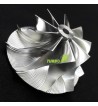
An MFS wheel Performance may have a geometry suited to the task, in particular in terms of its profile, the height or width of its blades, their arrangement or its diameter. On this product, the MFS wheel shown is made of forged aluminium; it is lighter, larger and taller than the one d'original'; the product data indicates a further 15 per cent compression.
A standard MFS wheel can be just as shiny as an MFS wheel Performance. It is not its appearance that determines its performance, but its geometry and its ability to move more d'air'. A higher flow rate may go hand in hand with an increase in power when the engine has been properly tuned, although this alone does not guarantee a specific result.
Why does the geometry of the blades affect the flow rate? d'air?' ?
The compressor wheel draws in and then compresses the air fed to the engine. Its diameter, profile, height, width and the arrangement of the blades all influence its aerodynamic behaviour. The right geometry can move more d'air under certain operating conditions'.
The result also depends on the compressor housing, the impeller and the turbine housing, the boost pressure and the engine tuning. A larger wheel does not automatically guarantee better performance and may affect response time and range d'optimal use'.
Reliability and balancing of the hybrid turbocharger
The 360° bearing stop distributes axial forces over a wide area. It helps to adapt the bearing system to the stresses of the preparation process, without making the turbocharger insensitive to faults in assembly or lubrication.
The rotor is balanced at high speed, up to 150,000 rpm, on a Cimat VSR test bench. This operation is designed to minimise the vibrations and mechanical stresses generated during rotation.
Engine remapping and tuning
Making use of characteristics d'A hybrid turbo requires appropriate engine management'. The mapping, boost pressure and wastegate settings must be checked when remapping the ECU.
Depending on the level of preparation, it is also advisable to check whether or d'adjust the fuel injection, exhaust, cooling, intake and, if necessary, the transmission'. The editing d'A hybrid turbo does not automatically guarantee a power boost without the right set-up'.
Turbo part numbers
OEM part numbers
55220701
55229857
55230178
55239695
55246405
71724375
71794564
71794566
Manufacturer’s part numbers
766924-0001
766924-1
766924-5001S
784521-0001
784521-1
784521-5001S
803956-0002
803956-0003
803956-2
803956-3
803956-5002S
803956-5003S
GT1446Z
Compatible vehicles and assignments
Fiat
Idea — 1.6 D Multijet 120 hp
Engine 1.6 D Multijet — May 2008 to an unspecified date
Engine code : not specified
Punto EVO (199) — 1.6 D Multijet 120 hp
Engine 1.6 D Multijet — October 2009 to February 2012
Engine code : not specified
Lancia
Delta III (844) — 1.6 D Multijet 116 hp
Engine 1.6 D Multijet — August 2008 to an unspecified date
Engine code : not specified
Musa (350) — 1.6 D Multijet 116 hp
Engine 1.6 D Multijet — July 2008 to an unspecified date
Engine code : not specified
Musa (350) — 1.6 D Multijet 120 hp
Engine 1.6 D Multijet — July 2008 to an unspecified date
Engine code : not specified
Additional technical specifications
Product type: hybrid turbo
Turbo model: GT1446Z
Engine: 1.6 D / JTD / Multijet
Fuel: diesel
Power : 116 and 120 hp
Engine code : not specified
Installation: plug & play, without any changes to the layout
Assembly instructions
⚠️ WARNING — IMPORTANT BEFORE ASSEMBLY
Before installation, identify and rectify the cause of the previous fault. Check the lubrication circuit, the supply and the return d'the oil and the cleanliness of all the pipes'.
Check the intake and ensure there are no foreign objects present. Carry out the priming in accordance with the relevant guidelines and follow the vehicle manufacturer’s instructions.
If a lubrication fault is not rectified, it may lead to the turbocharger failing again.
How do you choose the right turbo ?
Check the part number marked on the turbocharger d'origin and compare it with the OEM and manufacturer part numbers listed on this sheet'. Also check the make, model, generation, engine type and power output in hp, the assembly period and the engine code, where available.
The same engine can be fitted with several different turbo set-ups. The single designation 1.6 D, , JTD or Multijet is therefore not always sufficient to confirm compatibility.
⚠️ Check your turbo’s part numbers
Before placing your order, Compare the part number on your turbocharger d'origin' using the references given in this fact sheet. Having the same motor does not always guarantee compatibility.
If you are in any doubt, please contact us with the full part number from your turbocharger.